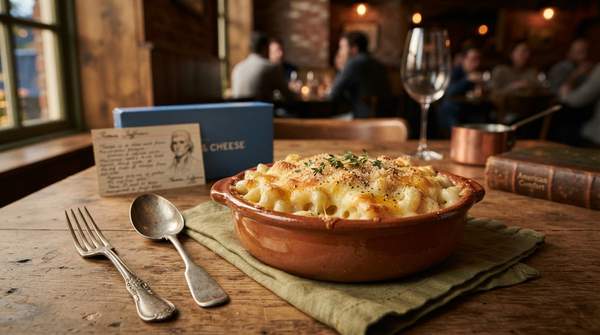
Mac and cheese didn't start as the humble pantry staple we know today. Its earliest known recipe traces to 14th- and 15th-century Italy, and it arrived in America as a dish for presidents and their guests. The real turning point came in 1937, when a boxed version fed a family of four for under 20 cents during the Great Depression. That single pivot transformed an elite curiosity into a mass-market staple, and today it has been reinvented once more as a canvas for truffle oil and lobster.
The European Origins of Mac and Cheese
References to dishes combining cheese and pasta go back more than 500 years, with Epicurious's history of the dish pointing to 14th- and 15th-century Italy as the earliest documented source. That makes mac and cheese older than the printing press, though the earliest known recipe is exactly that: the earliest we know of, not proof that no earlier version existed.
What those early Italian dishes looked like is worth savoring. Pasta and cheese, cooked together into something warm and simple, was already recognizable as the comfort food logic we still follow: starch plus melted fat plus salt. The dish survived centuries of European kitchens because it solved a problem that never goes out of style — turning cheap staples into something luxurious.
Mac and Cheese Arrives in America: A Dish for the Elite
The man credited with bringing mac and cheese to America is Thomas Jefferson. According to Epicurious's account, Jefferson encountered macaroni in France and Northern Italy in the late 1700s and was, by all accounts, smitten. He was so taken with the elbow-shaped pasta that he had a special macaroni extruder shipped back to Virginia.
Jefferson then served the dish to friends and guests — even at presidential dinners. That detail matters. In post-colonial America, mac and cheese was not peasant food; it was a status dish, an exotic import enjoyed by the young republic's elite. The dish's American debut was at the top of the social ladder, not the bottom.
From Elite Tables to American Kitchens: Early Recipes
A few decades after Jefferson's dinners, the dish began its descent from the presidential table to the family kitchen. Mary Randolph, a distant cousin of Jefferson's, included a macaroni and cheese recipe in her highly influential cookbook, The Virginia Housewife, published in 1824.
Randolph's version was stripped to its essence: just three ingredients — macaroni, cheese, and butter. No béchamel, no breadcrumbs, no fuss. The influence of her cookbook helped the recipe spread through American households, giving home cooks a written formula for a dish that had previously lived mostly in the memories of cooks and the notebooks of the wealthy.
The Great Depression and Mass Market Success
The dish's great democratizing moment arrived in 1937, when Kraft produced a boxed version of macaroni and cheese. The timing could not have been better — or worse. The country was still in the grips of the Great Depression, and a single box could feed a family of four for less than 20 cents.
As Epicurious puts it, the boxed version "sold like hot cakes." Affordability and convenience converged: a shelf-stable box, a pot of boiling water, and dinner was served. This is the socio-economic heart of the story. A dish that began as a presidential indulgence became, almost overnight, the cheapest hot meal a struggling family could put on the table. The Great Depression didn't just coincide with mac and cheese's rise — it drove it.
Timeline: The Evolution of Mac and Cheese
| Date/Era | Key Development | Key Figure/Entity | Significance |
|---|---|---|---|
| 14th–15th century | Earliest known recipes combining pasta and cheese | Italian cooks | Earliest documented precursor; not necessarily the absolute first |
| Late 1700s | Macaroni encountered in France and Northern Italy; extruder shipped to Virginia | Thomas Jefferson | Credited with introducing the dish to America |
| Late 1700s–early 1800s | Dish served to guests, including at presidential dinners | Thomas Jefferson | Established mac and cheese as an elite, high-status dish |
| 1824 | Recipe published in The Virginia Housewife | Mary Randolph | Influential cookbook spread the recipe to American households |
| 1937 | Boxed macaroni and cheese introduced | Kraft | Shift toward mass availability and convenience |
| 1930s | Marketed as a family-of-four meal for under 20 cents | Kraft | Depression-era affordability drove explosive popularity |
| Late 20th/21st century | Gourmet variations emerge | Chefs and home cooks | Dish reimagined with bacon, truffle, and lobster |
Read top to bottom, the timeline shows the pattern: each stage of mac and cheese's history was driven by a different economic force — aristocratic curiosity, cookbook literacy, and industrial convenience.
Modern Reinvention: Gourmet Mac and Cheese
The most recent chapter inverts the dish's journey once more. As Epicurious's history recounts, mac and cheese has "gone on to make best friends with bacon, truffle, and lobster." The cheapest meal of the Depression era now appears on restaurant menus dressed in ingredients that cost more than the original boxed dinner did for a family of four.
Whether boxed or homemade, the dish settled into its role as an American staple. The gourmet turn doesn't erase its humble associations — it leans on them. Truffle mac and cheese works precisely because everyone recognizes the base dish as comfort itself.
Understanding Mac and Cheese's Enduring Appeal
Recognize that mac and cheese's journey reflects broader socio-economic shifts: from elite indulgence to affordable staple, and now a versatile gourmet item. The decision for the curious reader is to see the dish not as one thing, but as three — a presidential import, a Depression-era lifeline, and a chef's canvas.
The measurable indicator of its continued relevance is the continued appearance of new gourmet mac and cheese variations and its consistent presence in comfort food discussions. Watch for that: every new truffle-and-lobster menu listing or boxed-dinner reinvention is the next chapter of a story that started in 14th-century Italy and shows no sign of ending.
Sources
- The Secret History of Mac & Cheese — Epicurious