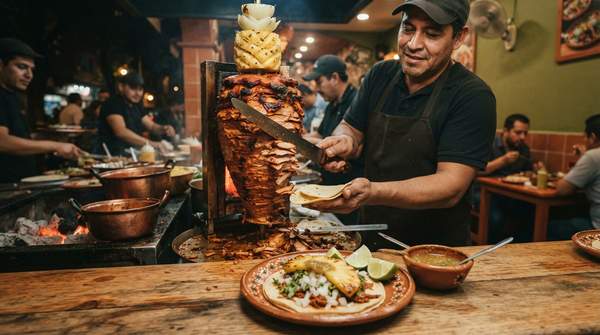
Tacos al pastor is one of Mexico's most beloved street foods, but its signature spinning vertical spit, its chile-stained pork, and even that crown of pineapple trace back, layer by layer, to Lebanese immigrants and their shawarma. The transformation was gradual and collective rather than the work of a single inventor: different businesses, families, and cities contributed to the dish we know today, with the Mexican-born children of those immigrants in Puebla completing the decisive pivot toward pork, corn tortillas, and local chiles during the 1960s. Food historian Jeffrey Pilcher, cited in accounts of the taco's history, describes al pastor as a later development from this immigrant food history rather than a tidy one-line invention story. That complexity is exactly what makes the dish worth understanding.
Lebanese Immigration to Mexico and the Birth of Tacos Árabes
The story begins with the vertical spit itself. A history compiled by HistoricalMX traces the technology to the Ottoman Empire, where the vertical spit was invented during the 14th century and became the standard way to prepare shawarma — spit-roasted lamb served on pita bread, a dish whose popularity spread throughout the empire. Lebanese migrants carried that tradition abroad for reasons the same history summarizes plainly: evading military conscription, escaping violence, and seeking better economic opportunities.
In Mexico, many of those immigrants settled, and by the 1930s some opened their own restaurants serving the popular Middle Eastern dish. Their shawarma did not stay foreign for long. A bridge dish soon appeared — tacos arabes, which HistoricalMX describes as a variation of shawarma featuring lamb served on a flour tortilla. Tacos arabes are strongly associated with Puebla, and Pilcher's account positions them as the essential connecting point between Middle Eastern roasting traditions and what later became al pastor. The name itself, "Arab tacos," announced exactly what the dish was: an immigrant tradition beginning to speak Mexican.
The Evolution of Tacos al Pastor: A Culinary Timeline
Reading the dish's history stage by stage makes the transformation legible. Each row below tracks the same lineage through a different era, showing how the name, the meat, the cooking method, and the accompaniments shifted together — the step-by-step evolution from Ottoman shawarma to a distinct Mexican taco.
| Time Period | Dish Name | Key Meat | Cooking Method | Key Ingredients / Accompaniments | Location |
|---|---|---|---|---|---|
| 14th century onward | Shawarma | Lamb | Vertical spit (invented in the Ottoman Empire) | Served on pita bread | Ottoman Empire |
| 1930s | Shawarma in Mexico | Lamb | Vertical spit brought by Lebanese immigrants | Pita bread; immigrants opened restaurants serving the Middle Eastern dish | Mexico, notably Puebla |
| Mid-20th century | Tacos árabes | Lamb | Vertical spit | Flour tortilla instead of pita | Puebla |
| 1960s | Tacos al pastor | Pork | Vertical spit (trompo) | Corn tortillas; marinade of Mexican spices and chilies; pineapple added at some point | Puebla |
| 1960s–present | Tacos al pastor as standard | Pork | Trompo with achiote-and-chile marinade | Small corn tortillas, onion, coriander, pineapple slice in traditional Mexico City service | Mexico City and nationwide |
The timeline shows the logic of the changes: each stage kept the spit, the centerpiece of the technique, while swapping nearly everything around it for what was local and available.