By around age 11, most children are ready to move well past stirring and sprinkling: with the right instruction and consistent adult supervision, they can plan a family meal, follow a recipe on their own, cook simple dishes on the stovetop, and bake with the oven. That is the consensus that emerges from expert sources ranging from a children's cooking school to a pediatric health organization, and the payoff is bigger than dinner. Kids who cook build a practical life skill, and families who cook together tend to eat better, too — the Heart and Stroke Foundation of Canada notes that learning kitchen basics supports healthy food choices and, over time, a lower risk of high blood pressure, heart disease and stroke.
Core Principles for Teaching Kitchen Independence
The first principle is the one every source repeats: children vary, and you are the judge of readiness. The Good Food team's age-by-age guide is blunt on this point — children will differ in their ability to undertake different cooking activities, and parents should use their own judgment to choose suitable tasks. The same guide adds that if a child does not seem ready for a skill, hold off for a while; safety outranks any age-based checklist.
Second, build independence through small, achievable steps rather than perfect results. Young Chefs Academy, a children's cooking school, frames each new skill as another chance for a child to say "I can do this," with independence built one small step at a time. Connecticut Children's, a pediatric medical organization, echoes this: involve your child in planning — they'll be more open to trying new foods when they have a say — and accept that trial and error is part of the process.
Third, establish food safety as a non-negotiable habit before any cooking begins. Connecticut Children's recommends hand washing for at least 20 seconds with soap and running water, proper cleaning and storage of food at the right temperature, and limiting cross contamination. The Heart and Stroke Foundation adds a lesson children at this age can fully grasp: raw meat, chicken and eggs harbour bacteria and must never share a cutting board or plate with fresh vegetables.
3-Tier Skill Progression Framework for Ages 9-11
The table below organizes the recommended skills into three tiers, ordered from lowest to highest hazard, so you can match tasks to your child's current dexterity and attention rather than their birthdate. Each tier builds directly on the one before it — a child who cannot yet measure accurately or follow a recipe's order is not ready for a hot pan, no matter how eager they are.
| Skill Category | Specific Skills | Key Safety Checks | Signs of Readiness |
|---|---|---|---|
| Advanced Prep | Accurate measuring; using a peeler and grater; opening cans; whisking (balloon whisk or handheld mixer); making salads; handling raw meat carefully; understanding cooking terms like bake, broil, roast, sauté and stir-fry | Adult supervision for sharp tools; strict separation of raw meat from fresh produce; wash hands before starting | Follows a simple recipe in order; understands teaspoon vs. tablespoon; picks the right measuring tool unprompted |
| Stovetop Cooking | Cooking basic stovetop meals such as soups, pasta, scrambled eggs and tacos; boiling and sautéing | Never leave a child unattended near heat; tie back long hair; avoid loose clothing; hot-pan handling taught directly | Masters prep tier independently; understands the risks of high heat; stays focused through multi-step tasks |
| Oven & Independent Meal-Making | Baking simple recipes like cookies or muffins; using the oven with check-ins; planning family meals; preparing simple breakfasts and lunches independently; making a shopping list; locating ingredients; reading nutrition labels; cleaning up afterward | Direct adult supervision for oven use; teach safe handling of hot pans and trays before the first bake | Completes stovetop tasks with supervision; manages multiple components of a meal; plans ahead without prompting |
The reasoning behind this sequence is simple: dexterity and hazard exposure rise together. Prep work sharpens tools but involves no heat, so mistakes are usually recoverable. Stovetop cooking combines sharp, hot and fast-moving elements, which is why supervision must be constant. Oven work adds sustained high heat and timing demands, which is why Treehouse Schoolhouse's kitchen-skills checklist places it alongside — not before — planning a family meal, and describes oven use at this age as "with check-ins" rather than solo.
Tier 1: Advanced Prep Skills
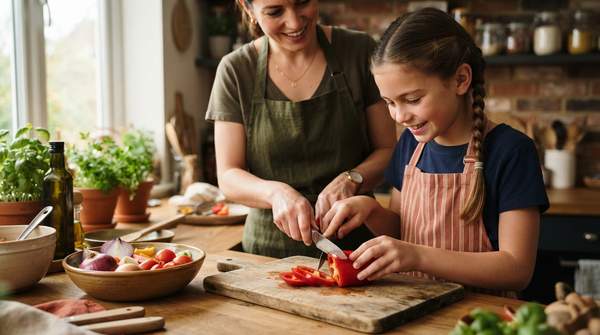
This is where the sharper end of kitchen life begins. Ten-year-olds may be too young for a real chef's knife depending on dexterity, as the Heart and Stroke Foundation cautions, but they can certainly manage a carrot peeler or cheese grater with some adult supervision. Add opening cans, whisking with a balloon whisk or handheld mixer, and assembling salads, and you have a tier that produces genuine contributions to dinner — grated cheese, prepped vegetables, a dressed salad — while a parent handles the heat.
Tier 2: Stovetop Cooking Basics
Treehouse Schoolhouse's checklist lists cooking basic stovetop meals — soups, pasta, eggs, tacos — among the skills children develop in this age window, and the Heart and Stroke Foundation's skills list builds toward understanding what boiling and sautéing actually mean on the stove. The safety rules are the same in every source: stay present, tie back long hair, skip loose sleeves, and teach how to handle a hot pan handle before your child ever lifts one. Cuts and burns are common in kitchens, as the Good Food guide warns, and even capable children get distracted or rush.
Tier 3: Oven and Independent Meal-Making
The top tier is where cooking becomes self-direction. The Good Food guide's activities for 8-to-11-year-olds include planning the family meal, finding ingredients in the cupboards and fridge, and using heat on a hob, oven and microwave. Treehouse Schoolhouse goes further, listing baking simple recipes independently, using the oven safely with check-ins, preparing simple breakfasts and lunches without help, and reading nutrition labels. This is also the age, their checklist notes, when children "turn a corner" toward accepting fuller responsibility — provided the groundwork and supervision are there.
Ensuring Safety: Essential Kitchen Rules for Pre-Teens
A few rules apply across every tier. Supervision remains key at this age due to the number of hazards in the kitchen, in the Good Food team's words, but their advice is to take a hands-off approach where possible — watch closely, intervene rarely, and let the child do the work. That balance matters: hovering teaches nothing, but absence invites accidents.
Before each new skill, name the specific danger out loud — splattering oil, a grater's edge, a hot oven rack — so your child knows what they are avoiding, as the Good Food guide recommends when introducing hazards. Keep a clear path around work areas and the stove so panic never has to negotiate a obstacle course. And keep the food-safety habits from Tier 1 in force forever: hands washed before cooking, raw meat quarantined on its own board, everything stored at the right temperature, with package labels or a dietitian as the reference when in doubt, per Connecticut Children's.
Finally, resist the urge to rescue every wobble. Connecticut Children's suggests expanding skills gradually — trying new cuisines together, beating eggs, or for older kids, chopping onions — and leaning on the abundant resources available, from cookbooks to tutorials, when you need a teaching script. Not every recipe will be a favorite, their guidance acknowledges, and some trial and error is simply the tuition for a lifelong skill.
Empowering Young Chefs: Next Steps for Parents
Parents should consistently involve children aged 9-11 in kitchen tasks, progressively introducing new skills from advanced prep to stovetop and oven use, always prioritizing safety and fostering independence. A workable starting plan: one regular cooking session a week, as Connecticut Children's suggests — whether monthly or weekly, the habit matters more than the frequency — with your child choosing the dish, prepping everything in Tier 1, and graduating to stovetop or oven tasks only after the prep tier is solid. Judge each step against your own child's maturity and dexterity rather than the calendar, remember that knife work and all heat-based skills call for direct adult supervision, and treat this guide as general education rather than medical or child-development advice.
The measurable indicator of progress is concrete: increased child participation in meal preparation and a demonstrated understanding of kitchen safety rules. When your 10- or 11-year-old can wash up unprompted, keep raw chicken off the salad board, get a simple soup from recipe to bowl with you nearby but not needed, and plan next week's family dinner themselves, the framework has done its job — and dinner has a new author.
Sources
- What Cooking Skills Should Kids Know at Every Age? — Young Chefs® Academy
- Kids in the Kitchen: Essential Cooking Skills for the Whole Family — Connecticut Children's
- 10 kitchen skills every 10-year-old should know — Heart and Stroke Foundation of Canada
- A guide to cookery skills by age — Good Food
- Kitchen Skills for Kids: Cooking for Every Age [Checklist PDF] | Treehouse Schoolhouse Blog