The secret to successful ingredient substitution isn't a memorized chart—it's knowing what the original ingredient actually does in the recipe. As NDSU Extension food and nutrition specialist Julie Garden-Robinson puts it in her guide on ingredient substitutions, "Each ingredient in a recipe has a specific function," and swapping one for another "may alter the taste, color, moisture content or texture of the product." That principle is your compass. Classify first, substitute second, predict the consequences third.
Understanding Ingredient Function: The Key to Smart Swaps
Every recipe is a system of jobs waiting to be filled. Some ingredients build structure, some deliver moisture, some carry fat and richness, some create lift, and some exist purely to flavor. McCormick's baking guidance frames it simply: "Baking is a balance of structure, moisture, and flavor, and every component plays a role."
Before you panic about a missing ingredient, ask what would be lost if you simply omitted it. Flour disappears, and the cake has nothing to hold it together. Eggs vanish, and structure and moisture both suffer. New Mexico State University's extension guidance adds a useful distinction: when "equivalent ingredients are substituted, very little, if any, change will be noticed in the finished product," but substituting a merely similar ingredient—one with different properties—can change the final quality in flavor, color, or texture.
Ingredient Substitution Decision Framework
Here is the working method: identify the function, pick a replacement that performs that same function, then weigh the trade-off. The matrix below organizes the most common swaps by role, using ratios and outcomes drawn from extension-published guidance.
| Step | Question to ask | Worked example |
|---|---|---|
| 1. Classify | What job does this ingredient do here—structure, moisture, fat, leavening, or flavor? | Butter in a cookie recipe = fat plus moisture plus flavor |
| 2. Match | Which substitute performs the same primary job? | Butter → vegetable oil or applesauce, both fats/moisture carriers |
| 3. Predict | What changes in texture, flavor, volume, or cooking time? | Oil creates a softer texture; solid fats maintain more structure |
The evidence-derived result: when your substitute performs the same primary function at a similar ratio, you can usually anticipate the outcome before you preheat the oven. Food Network's substitution guide notes its suggestions are one-to-one unless otherwise stated, meaning the ratios below are starting points, not guarantees.
Structure: Building the Foundation
Flour is the backbone of baking—"Flour provides structure, giving baked goods their shape and stability," as McCormick's guide explains. That's why structural swaps demand the most care. Hershey's substitution chart offers concrete alternatives: 1 cup of all-purpose flour can be replaced with 7/8 cup of rice flour or 3/4 cup of chickpea flour. Those different flours carry different protein and gluten behavior, so the crumb and stability of the final product shift with the choice.
Eggs play a double role—structure and moisture—which makes them tricky to replace cleanly. Food Network's guidance warns that egg substitutes are the category most likely to change texture and cooking times, and each option produces a slightly different result. In practice, that means structural substitutions deserve a small test batch before you commit the whole recipe.
Moisture & Fat: Influencing Texture and Richness
Fat is where substitutions get deliciously forgiving, because fat's job is richness and moisture rather than architecture. Butter can be replaced with oils or other fats depending on the recipe, McCormick notes—and the form of the fat matters more than its source. A replacement like vegetable oil creates a softer texture, while solid fats maintain more structure.
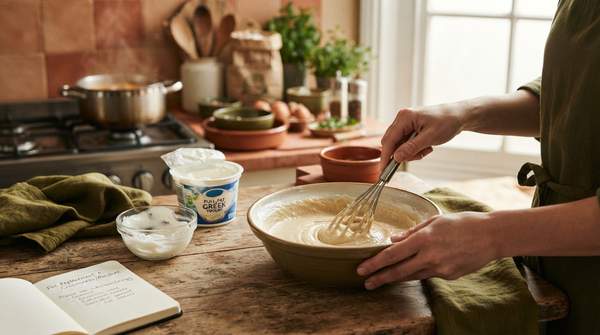
Milk swaps are gentler still: plant-based alternatives often work without dramatic consequences because milk's role is largely moisture. The same principle applies in savory cooking, where NMSU's guide cites plain yogurt standing in for sour cream in a salad dressing—a similar-property swap that may change quality characteristics but keeps the dish intact.
Leavening & Flavor: The Science and Art of Taste
Leavening is chemistry, not preference. Utah State University's extension list provides precise ratios: 1 teaspoon of baking powder can be replaced with 1/4 teaspoon baking soda plus 5/8 teaspoon cream of tartar, or with 1/4 teaspoon baking soda plus fully soured milk or buttermilk. The reason is functional—carbon dioxide must be released to make the product rise, and "an acid ingredient must be present to react with the soda," as the USU guidance explains. Molasses is acidic enough to do the job.
Yeast follows the same logic: 1 tablespoon of active dry yeast equals one package of active dry yeast or one compressed yeast cake. Flavor substitutions—extracts and spices—are the most forgiving territory, since their only function is taste, and the dish's structure is unaffected.
Baking vs. Cooking: Why Precision Matters More in Baking
Here's the trade-off every cook should internalize: the stovetop forgives, the oven does not. Food Network's guide concedes that "the final appearance, taste and texture may be altered (especially in baking)" after a substitution—baking's dependence on structure and leavening means a wrong ratio collapses the whole system. A stew missing an herb simply tastes different; a cake missing its acid for the baking soda simply doesn't rise.
USU's guidance echoes this: a substitution "can sometimes alter the flavor, color, texture or volume of the food, but will still result in an acceptable finished product"—with volume changes mattering almost exclusively in baked goods. So calibrate your caution accordingly: improvise boldly in soups and sauces, measure carefully when flour, eggs, or leavening are involved.
Making Confident Ingredient Swaps
The decision: when faced with a missing ingredient, assess its primary functional role in the recipe—structure, moisture, fat, leavening, or flavor—before selecting a substitute, to minimize unexpected changes in the final dish. The substitutions covered here are common, basic swaps; results vary by recipe, ratios are general guidelines, and complex allergen-free baking (like gluten-free and egg-free at once) sits beyond this framework's scope.
The measurable indicator of success: the ability to confidently choose a substitute and anticipate its impact on the recipe's outcome, leading to fewer failed dishes and more successful culinary adaptations. Your next milestone is a small one—pick one swap from the matrix, run it in a familiar recipe, and taste whether the prediction held.
Sources
- Ingredient Substitutions — NDSU Agriculture
- Baking Substitutions: How to Make Smart Swaps — McCormick
- In a Pinch Ingredient Substitution | New Mexico State University - BE BOLD. Shape the Future. — PUBS
- Ingredient Substitution Guide — Food Network
- Common Baking Ingredient Substitutes — Hersheyland
- List of Ingredient Substitutions for Cooking and Baking — Extension