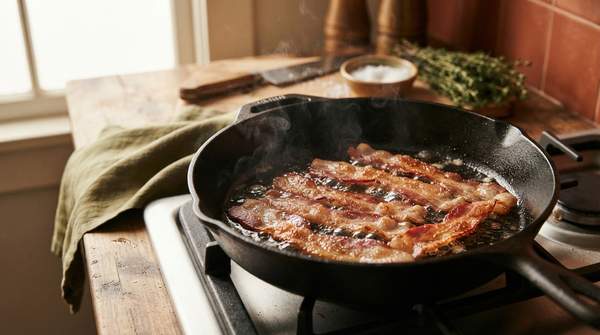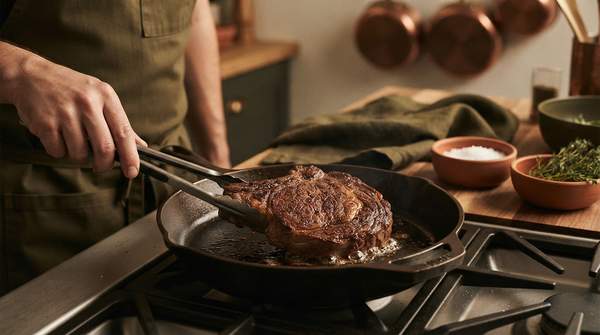
That deep, savory crust on a seared steak or roasted carrot is not just browning—it's flavor being manufactured in real time. The Maillard reaction, a series of chemical reactions between amino acids and sugars, produces the "deep, meaty, roasted, nutty, or toasty flavors that define so many cooked foods," as the culinary team at Modernist Cuisine puts it, arguing it "should be called 'the flavor reaction,' not the 'browning reaction.'" The good news for home cooks: you don't need luck to get there. You need to manage four variables—temperature, moisture, pH, and time.
The Four Levers of Flavor: Temperature
Heat is the engine of the reaction, and it works in two ways at once. High-temperature cooking speeds the Maillard reaction both by increasing the rate of the underlying chemical reactions and by accelerating the evaporation of water, which concentrates reactants at the food's surface and lets the temperature climb further, as Modernist Cuisine explains. But there's a stubborn physical limit: while food stays wet, its temperature cannot rise above the boiling point of water.
That's why searing and roasting demand genuinely high heat. The reaction becomes effective above roughly 140°C (285°F) and accelerates in the 140–165°C (280–330°F) range. The trade-off is real: scientific reviews note that in coffee roasting, lower temperatures can optimize flavor while minimizing undesirable byproducts, and in potato chips, lower cooking temperatures reduce acrylamide without sacrificing sensory quality. High heat is a tool, not a maxim—push it only as far as your food needs.
The Four Levers of Flavor: Moisture
Moisture is the variable most home cooks get wrong. A wet surface doesn't just brown slowly; it steams. As Modernist Cuisine's guidance on Maillard-maximizing techniques puts it, you should "remove as much water from the surface of the meat as possible before cooking it," whether by blotting or by drying at low temperature. The same logic applies to vegetables destined for a roasting pan.
The underlying science adds nuance: water activity influences the reaction rate, with optimal browning at intermediate moisture levels (aw = 0.6–0.7)—not bone-dry, not soaked. In practice, this means patting food dry, avoiding overcrowded pans that trap steam, and giving water somewhere to escape. Every drop that evaporates before browning begins is a drop that isn't steaming your dinner into pallid submission.
The Four Levers of Flavor: pH (Acidity and Alkalinity)
The quietest lever is also one of the most powerful. The Maillard reaction proceeds faster under basic conditions than at acidic pH levels, a review of the reaction's food-industrial applications notes, because alkaline environments deprotonate amino groups and make them more reactive. This is the same chemistry behind lye-darkened pretzels. In the other direction, a pH at or below 5 is enough to stop the reaction entirely during moderate heating processes.
Food scientists manipulate pH deliberately through ingredient selection and processing to control appearance, taste, and texture—and home cooks can borrow the trick. A pinch of baking soda in caramelized onions or braising liquid nudges the surface toward alkalinity and accelerates browning dramatically. Acidic marinades, meanwhile, will slow your crust down; that's worth knowing before you blame your pan.
The Four Levers of Flavor: Time
Time compounds everything else. The duration of heating significantly shapes flavor and aroma development, and longer cooking generally means deeper browning—but it's a diminishing-returns curve. Prolonged heating can veer into burnt flavors and, in starchy foods especially, increased formation of acrylamide, a probable carcinogen that forms at high temperatures. Reviews of acrylamide in food find the highest levels in low-moisture, high-temperature-processed products like potato crisps, biscuits, and instant coffee, while raw or boiled foods contain negligible amounts.
The practical takeaway: acrylamide formation depends on both temperature and time together, so a hard, fast sear on a wet-but-dried surface often beats a long slog. When a recipe calls for extended high heat on a starchy food, that's the moment to stay alert, not walk away.
Maillard Reaction Troubleshooting Framework
Use this matrix to diagnose what went wrong and which lever to pull next. Each row connects a common kitchen failure to the variable responsible and the corrective action the science supports.
| Problem in the Pan | Variable to Adjust | Why It Happens | Corrective Action |
|---|---|---|---|
| Food is steaming, not browning | Moisture | Wet surfaces can't exceed the boiling point of water, so the reaction can't get going | Pat surfaces dry before cooking; don't overcrowd the pan; let steam escape |
| Exterior burns before the inside cooks | Temperature (with Time) | Reaction accelerates with heat, but so does burning | Lower the temperature slightly and extend time; pull the food once the crust is set |
| Vegetables or tough cuts refuse to brown | pH | Acidic conditions slow or halt the reaction; pH ≤ 5 stops it during moderate heating | Add a small pinch of baking soda to shift the surface toward alkalinity |
| Pale meat after a long roast | Temperature | Gentle oven heat may never dry the surface enough to push past water's boiling point | Sear at high heat first, or finish under intense direct heat to drive surface drying |
| Flavor is dull and flat despite browning | Time | Duration shapes which aroma compounds develop | Adjust length of browning stage; pair heat level with the time the food can tolerate |
| Starchy food browns too dark, too long | Time and Temperature | Long, hot cooking of low-moisture starchy foods drives acrylamide up | Shorten the high-heat stage and pull at deep golden rather than dark brown |
The framework works because the four levers interact. Drying a surface is what allows temperature to do its job; alkalinity buys you browning at lower temperatures; time only counts once the surface is dry and hot. When something goes wrong, identify which precondition failed rather than reaching reflexively for more heat.
Consistently Achieve Deep Flavor and Perfect Browning
To consistently achieve optimal browning and rich flavor, home cooks should actively manage temperature, moisture, pH, and time based on the specific food and desired outcome. Dry the surface, heat hard enough to push past the boiling point, nudge alkaline when a food resists browning, and stop the clock before burn and excess acrylamide enter the picture.
The measure of success is simple and observable: the food consistently develops a deep golden-brown crust and complex savory aromas. When that happens, the reaction has run on your terms—and when it doesn't, you now know exactly which lever to reach for.