Every perfectly roasted carrot or bronzed potato wedge owes its flavor to two distinct chemical processes, and knowing which one you're chasing is the difference between soggy disappointment and vegetables people actually fight over. The Maillard reaction — a non-enzymatic reaction between amino acids and reducing sugars — creates the deep, savory, roasted, nutty flavors and brown crusts. Caramelization, a separate process involving only sugars breaking down under heat, delivers sweetness and golden color. Both demand heat above roughly 140–165°C, and both stall completely if your vegetables are wet or crowded. Master temperature and moisture, and you control the flavor.
The Science of Delicious: Maillard Reaction vs. Caramelization
Let's clear up the most common confusion first. The Maillard reaction is often mistakenly described as just "browning," but as the team at Modernist Cuisine puts it, it's so much more: "it should be called 'the flavor reaction,' not the 'browning reaction.'" The molecules it produces provide the potent aromas responsible for the characteristic smells of roasting, baking, and frying. Chemically, it's a reaction between an amino group — amino acids, the building blocks of proteins — and a carbonyl group, typically reducing sugars like glucose. The result is melanoidins, the compounds that give browned food its distinctive flavor and color.
Caramelization is the simpler sibling. It involves only sugars breaking down under heat, with no amino acids required, and it needs higher temperatures — typically above 160°C — to get going. It produces sweet, nutty, and slightly bitter flavors along with that golden-brown glow. The two are often confused, and while they can happen simultaneously in the same food, they are chemically distinct processes producing different compounds and different results.
Here's why this matters for vegetables specifically: they contain both sugars and amino acids, which is why they brown during roasting. A scientific review published in Frontiers in Nutrition by Shuyun Liu and colleagues notes that the content and structure of reducing sugars have an important effect on the reaction's products — which is why a seared steak and a toasted slice of bread are both Maillard results yet taste nothing alike. Temperature, moisture, and timing each produce their own unique set of compounds.
The critical constraint is moisture. The Maillard reaction begins noticeably around 140–165°C and accelerates as temperature increases — but a wet surface can never exceed 100°C, the boiling point of water. Until that surface water evaporates, browning is physically impossible. This single fact explains most roasting failures.
Mastering Flavor: Your Roasting Decision Framework
Now the practical part. The framework below maps what you want on the plate — savory depth, concentrated sweetness, or both — to the adjustments that get you there. The underlying logic is simple: browning requires a hot, dry surface, so every strategy either protects that surface or deliberately manages the moisture coming out of the vegetable itself.
| Flavor Goal | What's Happening Chemically | Key Technique Adjustments |
|---|---|---|
| Deep, savory browning (crispy edges, roasted depth) | Maillard reaction: amino acids and reducing sugars combining above ~140–165°C | Use high oven heat so the surface exceeds 140°C; dry vegetable surfaces thoroughly before oiling; spread pieces in a single layer with space between them so steam escapes instead of trapping |
| Concentrated sweetness (golden, caramelized edges) | Caramelization: sugars alone breaking down, typically above 160°C, alongside Maillard browning | Keep heat high enough to pass the sugar-breakdown threshold; maintain the same dry-surface and spacing rules, since trapped steam lowers surface temperature and blocks both reactions |
| Both browning and sweetness, tender interior | Both reactions running on a dry exterior while interior moisture keeps flesh soft | High heat plus generous pan space; cut pieces large enough that the inside stays moist while the outside dries and browns |
Notice what every row shares: high heat, a dry surface, and room in the pan. That's not a coincidence — it's the physics of the reaction. Crowding the pan traps moisture and lowers the temperature around each piece, which is why the same tray of cauliflower, sprouts, or carrots can emerge fragrant and colored on one occasion and pale and steaming on another. The evidence supports these general high-heat principles across vegetables; it doesn't yet support meaningfully different temperature targets for starchy versus high-sugar vegetables, so treat the framework as universal rather than vegetable-specific.
Troubleshooting Common Roasting Problems
Problem: My vegetables steamed instead of browned. This is the classic failure, and it's almost always moisture. If the pan is crowded, the water evaporating from the vegetables gets trapped between the pieces, surrounding them in steam and holding the surface at or below 100°C — well below where either reaction can occur. The fix: give every piece breathing room, use a larger pan or two pans, and pat vegetables dry before they hit the oil. Modernist Cuisine's Maillard-maximizing advice is blunt on this point — remove as much surface water as possible before cooking, via blotting or drying.
Problem: The color is pale and the flavor is flat. Pale, bland vegetables usually mean the surface never got hot enough. Check your oven temperature with a thermometer, preheat fully before the tray goes in, and make sure you're using enough heat — the Maillard reaction only begins noticeably around 140–165°C and accelerates from there. A lukewarm oven can cook vegetables soft while never crossing the browning threshold at all.
Problem: Uneven results across the tray. Pieces at the center of a crowded pan steam while edge pieces brown — the same moisture-trapping mechanism at work within a single tray. Rearrange halfway through roasting, and keep piece sizes uniform so surfaces dry out and brown at the same rate.
Achieving Roasting Perfection: Your Next Steps
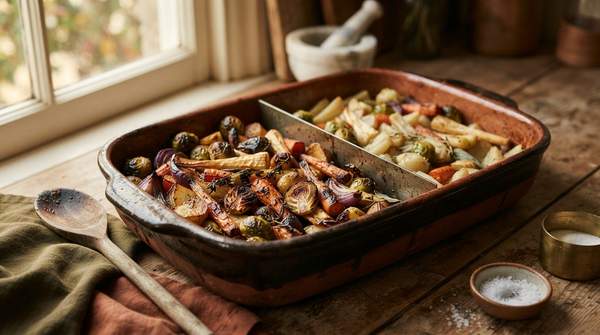
To consistently achieve the browning and sweetness you're after, prioritize three things: high heat, dry vegetable surfaces, and no crowding in the roasting pan. These aren't three separate tips — they're one principle, namely that flavor chemistry only happens on a hot, dry surface. The measurable indicator that you've succeeded is simple and checkable every time you cook: consistently browned, flavorful vegetables with a tender interior, free from sogginess. When you pull the next tray from the oven, look for golden-brown, fragrant edges and no pooled liquid underneath — that's the Maillard reaction and caramelization telling you, in the only language they speak, that you managed the heat and the moisture correctly.