Here is the short answer before we get flour on our hands: the texture of your bake is largely steered by two decisions about fat. First, its physical state — solid fats like butter and shortening build tenderness, flakiness, and lift, while liquid oils build moisture and density. Second, its timing — fat mixed in before gluten develops coats the flour and short-circuits structure for a tender, cake-like crumb, while fat added after gluten has formed lets a chewy, bread-like network survive. Get those two levers right, and you can dial in anything from a shattering biscuit to an open, chewy loaf.
The Science of Fat in Baking: Beyond Flavor
Flavor is the least interesting thing fat does in a dough. Yes, butter browns a crust beautifully and oils like rapeseed can lend a crumb a golden hue, as Prince Kumar notes in his baking science writing for Agriculture Institute. But fat's real job is architectural. It is the quiet negotiator standing between flour proteins and the water that would otherwise bind them into long, elastic gluten strands.
That matters because gluten is the skeleton of traditional baking. As the baking educator Baker Bettie explains, a strong gluten network stretches to trap leavening gases and produces baked goods with chew and sturdy structure, while a weak network produces ones that are light and tender. Fat is one of the most powerful tools for deciding which of those skeletons gets built — and, as a peer-reviewed study of semi-sweet biscuits published through the National Institutes of Health's archive puts it, in fat-rich products the overall quality is largely determined by the type of fat used.
Mechanism 1: The 'Shortening' Effect on Gluten
The word "shortening" is not a brand name; it is a verb. The biscuit research defines it as the ability of fats to lubricate, weaken, or shorten the structure of food components to give a product desirable texture. In practice, fat acts as a lubricant during mixing and prevents the formation of a gluten network in the dough — the proteins never get a clean chance to link up.
Bakery Academy describes the same process from the baker's bench: fats envelop gluten strands, inhibiting their interaction and network formation, which results in a softer, more tender texture. Fats also slow down the fixation of structure in developed doughs by coating those strands. Picture every particle of flour getting a thin raincoat before the water arrives. No hydration, no gluten, no chew — just a delicate, crumbly bite. This is the mechanism behind every tender pastry you have ever loved, and it is the reason a biscuit falls apart in the best possible way.
Mechanism 2: Physical State and Its Textural Impact
Solid and liquid fats do not wear their raincoats the same way. Solid fats bring a second trick: steam. When a solid fat melts in the oven, it generates steam that expands and creates lift within the dough, contributing to a lighter texture and a tender crumb, as Bakery Academy explains. Melting fat also releases trapped air, which aids leavening. This is the physics of flakiness — layers of solid fat melting into pockets of steam that push the surrounding dough apart.
Liquid oils play a different game. Because they blend seamlessly with other ingredients into a homogeneous mixture, they help retain moisture, producing baked goods that are moist and tender but denser — think muffins and certain cakes where a dense, moist crumb is exactly the point. Oils also disrupt the gluten network less than solid fats do, which is why the result reads as soft and uniform rather than flaky and open. One more wrinkle from Kumar's reporting: at higher proportions, liquid fats in particular can act as a liquefier and significantly alter dough hydration, so quantity changes the conversation, not just type.
Timing is Everything: When to Add Fat for Desired Texture
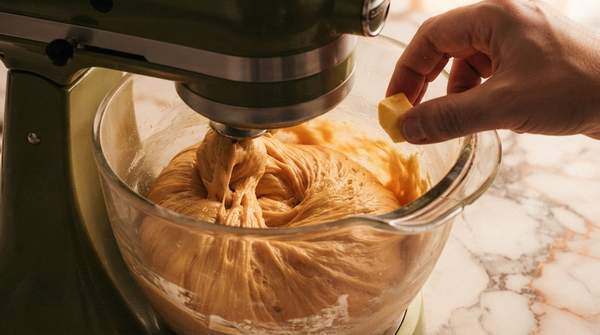
Here is the variable most home bakers never think to control. Kumar, citing the baking resource Cookistry, reports that if fat is added to bread dough before kneading, the result is a more cake-like texture; if it is added after gluten has developed, the result is more bread-like. The reason is pure mechanics: early fat addition coats the flour particles before strong gluten strands have formed, limiting gluten development significantly.
For most standard bread recipes, Kumar writes, incorporating fat after initial gluten development is optimal, as it enhances the dough's extensibility and tenderness without compromising the structural network needed to hold its shape and trap gas. And for higher-fat doughs, he relays the recommendation from the baking education site ChainBaker to add fat after some gluten development, especially once fat exceeds around 10% of flour weight. In other words, the clock on gluten development is the real control panel; the fat just decides how loudly it ticks.
Baking Fat Decision Framework
Use this table to work backward from the texture you want to the fat and the moment it belongs in the bowl. Each row maps a desired outcome to a fat state, a timing, the mechanism doing the work, and the crumb you should expect at the end.
| Desired Texture | Fat Type | Timing of Addition | Mechanism at Work | Resulting Crumb |
|---|---|---|---|---|
| Tender/short (biscuits, pastries) | Solid fat (butter, shortening) | Early, before significant gluten development | Fat coats flour proteins, inhibiting gluten network formation; melting fat releases steam for lift | Delicate, crumbly, flaky; reduced chewiness and a more tender mouthfeel |
| Chewy/structured (artisan bread) | Either solid or liquid; timing is the critical variable | After gluten has begun to develop | Gluten network forms first; fat then improves extensibility and tenderness without destroying structure | Strong, elastic, chewy crumb with gas-trapping ability |
| Moist/dense (muffins, certain cakes) | Liquid oil | Blended into the batter | Oil blends seamlessly, retains moisture, and disrupts gluten less than solid fats | Soft, moist, fine and uniform crumb; good moisture retention |
Read the table as a decision, not a menu: pick your target texture in the first column, then follow the row for your fat and your timing. If your result lands between two rows, you likely added the fat at a moment between the two windows — which is itself useful information for the next bake.
Achieving Specific Textures: Examples in Practice
Let's walk the rows. For a biscuit or flaky pastry, you want solid fat cut in early, cold and in pieces, so it coats the flour before any gluten can organize — the shortening effect plus steam-driven lift gives you that shattering tenderness. The biscuit study is blunt about it: fats perform a shortening function in dough, and in these fat-heavy products the fat type largely determines quality.
For a chewy loaf, the play is patience. Knead first, let the gluten start building its network, then add the fat — Kumar's reporting suggests this is the standard balance for most breads, and the ChainBaker guidance he relays says to hold fat back until after some gluten development, particularly above roughly 10% of flour weight. For a moist muffin or a dense, tender cake, reach for oil, whose liquid state blends into a homogeneous mixture that locks in moisture and yields that fine, uniform crumb Bakery Academy describes.
One honest caveat: this framework is built for traditional wheat-based baking with gluten. It is not a guide for gluten-free recipes, and it stays at the level of physical state rather than fatty acid chemistry. It gives you principles to apply to your own recipes, not the recipes themselves.
Mastering Texture: Your Next Baking Decision
To deliberately control the texture of your baked goods, choose your fat's physical state (solid for tenderness and flakiness, liquid for moisture and density) and the timing of its addition (early for tender, late for chewy) based on your desired outcome. The observable signal is the final crumb structure and mouthfeel of the baked good, which should consistently match the intended textural outcome based on the fat choice and timing. Bake one familiar recipe both ways — fat in early versus fat held back until the dough is smooth — and compare the two crumbs side by side. That single contrast will teach you more about gluten than any paragraph ever could.
Sources
- Impact of Fats on Bread Dough and Texture - Agriculture Notes by Agriculture.Institute — Agriculture Institute
- All About Gluten and its Role in Baking — Baker Bettie
- Effect of fat types on the structural and textural properties of dough and semi-sweet biscuit - PMC
- Fats and Oils the differences in baking - Bakery Academy