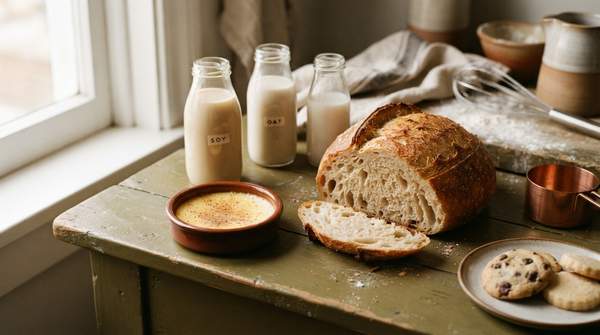
Swap the wrong non-dairy milk into a custard pie and you'll know it at the first slice: where dairy sets into something firm and silky, almond milk never thickens at all, and coconut milk thickens on the stove only to fall apart as it cools. Choose correctly, and nobody at the table will ever suspect the milk carton. The verdict from culinary testing is refreshingly simple: soy milk is the all-around champion when structure matters, oat milk is the creamy runner-up for nearly everything else, and rice milk belongs only where lightness and neutrality are the whole point. Here's the reasoning, plus a quick-reference table for your next bake.
The Role of Protein: Why Soy Milk Excels in Structure
Before we rank anything, it helps to understand what dairy milk is actually doing in your recipe. In a cake batter, a custard, or a creamy sauce, milk protein is quietly doing structural work — it sets as the dish cooks, it emulsifies sauces into something smooth rather than separated, and it gives doughs and batters the architecture they need to rise rather than collapse. When you remove dairy, you remove that protein scaffolding, and whatever you pour in as a replacement has to rebuild it.
This is where the numbers on the carton start earning their keep. The Chopping Block, a Chicago cooking school where instructor Ida writes on non-dairy substitution, is blunt about the hierarchy: of all the non-dairy milks on the shelf, soy milk has the most protein, about 5 to 7 grams per serving, alongside 3 to 4 grams of unsaturated fat depending on the brand. In her kitchen experience, that protein is precisely what makes soy milk the best choice for baking, because protein is vital for better structure in doughs and batters.
King Arthur Baking's 2024 test-kitchen trials turn that principle into a dessert. The baking company's team cooked custard pies and crème patissière with a range of vegan milks and measured the results against a dairy-milk original. Their finding: only soy milk yielded a custard that was nearly — though not quite — as thick and sliceable as the dairy version. Meanwhile, some vegan milks thickened nicely as they cooked and then fell apart as they cooled, coconut being the offender there, and almond milk never thickened at all. Same recipe, same heat, same technique. The only variable was the milk, and protein is what separated the sliceable from the soup.
One practical trick from the Chopping Block is worth stealing outright: when baking cakes and muffins, stir one tablespoon of apple cider vinegar into each cup of soy milk. The mixture mirrors buttermilk, which increases the leavening and makes your baked goods more tender — a two-ingredient upgrade that works specifically because soy's protein content is high enough to support the chemistry. A thinner, lower-protein milk would not carry off the same trick.
A fair caveat from the sensory side of the evidence: a scientific review of plant-based milk alternatives notes that the large insoluble particles in soy milk give it a chalky, grainy texture, and the natural pigments in soybeans give it a brownish cast. So soy wins on structure, not on raw aesthetics — a trade-off worth knowing if you're making something delicately pale where mouthfeel is on display.