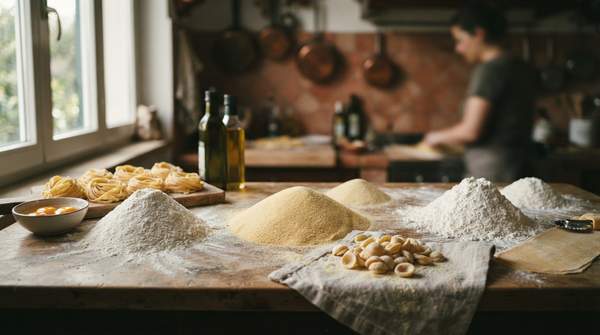
Here's the short answer before you even tie on an apron: if you're rolling tender, egg-based sheets—fettuccine, tagliatelle, ravioli—reach for Italian "00" flour, a finely milled soft wheat with roughly 10–12% protein. If you're shaping sturdy, eggless pasta like orecchiette or cavatelli, you want semolina, the golden, high-protein durum flour around 13–14% protein that delivers chew and structure. And all-purpose? It's the versatile middle path—workable, familiar, and perfectly respectable, if a little less distinctive.
Understanding Pasta Flour: The Foundation of Fresh Pasta
Fresh pasta is an ingredient-counting game with almost no room to hide. As the Italian miller Marco Cavallari of Mulino Padano puts it, the classic formula is nothing more than one hundred grams of flour per egg—and if you want excellent results, "you certainly cannot afford to get one wrong: the flour." With so few ingredients, the flour isn't a background player; it's the architecture.
That's why the answer to "what's the best flour?" is always a question back: what kind of pasta are you making? America's Test Kitchen frames it exactly this way—egg pasta doughs and semolina pasta doughs are different animals with different flour needs. The choice between tender and chewy, delicate and durable, gets made at the grocery store shelf, not at the cutting board.
Flour Fundamentals: Grind, Protein, and Gluten
Two properties do most of the work here: grind and protein. Grind determines how the flour feels and behaves—America's Test Kitchen describes 00 flour's texture as "talcum powder–like," a fineness that translates into smooth, easily rolled dough. In Italy, flour is categorized by refinement, as Nina Napolitano of Nina's Pasta Project explains: the system is based on ash content, essentially how refined the flour is, and the higher the type number, the coarser the grind.
Protein is the structural variable. More protein means more gluten potential, and more gluten means a dough that holds its shape and bites back a little. Semolina's higher protein develops into what Bob's Red Mill calls a strong gluten network, giving pasta firmness and chew. Lower-protein flours build less gluten, which is precisely why they produce softer, more tender noodles—and why matching protein level to your pasta style matters more than any brand loyalty.
Flour Comparison for Fresh Pasta
Here's the at-a-glance decision tool. Each row maps a flour's grind and protein to the texture it produces and the pasta shapes it serves best, so you can go from "I want to make ravioli tonight" straight to the right bag of flour.
| Flour Type | Grind / Character | Typical Protein | Resulting Texture | Best For |
|---|---|---|---|---|
| '00' flour | Very finely milled soft wheat; the most refined Italian type | ~10–12% | Silky, tender, delicate; rolls thin easily | Egg-based sheets and ribbons: fettuccine, tagliatelle, ravioli, lasagna |
| Semolina | Coarser grind of hard durum wheat; golden, sometimes called pasta flour | ~13–14% | Firm and chewy, with a rougher surface that grips sauce | Eggless shapes: orecchiette, cavatelli, malloreddus; extruded pastas |
| All-purpose | Standard pantry flour, moderate grind | Similar range to '00' | Softer and less distinctive than 00 or semolina results | Beginner-friendly, versatile fresh pasta when specialty flour isn't available |
The trade-off in one breath: 00 buys tenderness, semolina buys chew, all-purpose buys convenience. Pure Flour From Europe's guidance adds a practical note—choose unbleached all-purpose if that's your route, since bleached versions weaken the dough.
Egg vs. Eggless: Matching Flour to Dough Type
The egg question is the real fork in the road, and the flour logic follows from it. Egg pasta doughs, per America's Test Kitchen, are best made with white flour because it cooks up softer and is easier to work with due to its lower protein. The egg itself is doing binding work in the dough, so you don't need maximum gluten strength—what you want is a flour refined and moderate enough to roll into thin, pliable sheets that stay tender.
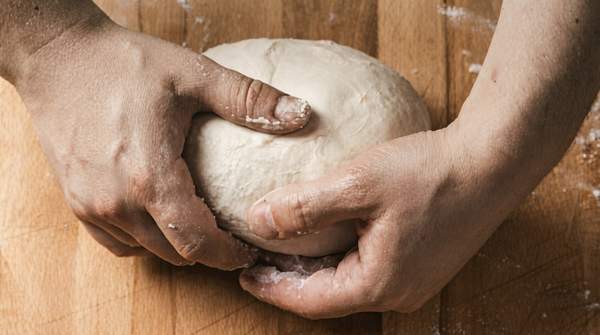
Flip to the eggless tradition and the requirements invert. Semolina pasta doughs are typically eggless, and the higher protein lessens the need for a binder. That strong gluten network is what lets a thumb-shaped orecchiette or a ridged malloreddus hold its form through shaping and cooking with nothing but flour and water. The honest cost, America's Test Kitchen notes, is effort: these sturdier doughs can require more work, especially without a pasta machine. Chewiness isn't an accident—it's the point.
Making Your Choice: A Practical Guide
So the decision tree is simple. Dreaming of silky ribbons or delicate filled pasta? Egg dough, 00 flour, thin sheets. Craving that rustic, sauce-grabbing chew in a hand-shaped pasta? Water and semolina, and put some muscle into the kneading. Out of specialty flour or just starting out? All-purpose will get you a respectable fresh pasta, with a texture that's softer and less distinctive than the 00 or semolina versions.
Two caveats worth keeping in your back pocket. These characteristics describe flour types generally—specific brands vary, so a "00" from one miller won't behave identically to another's. And this framework covers wheat flours only; gluten-free pasta making is a different science entirely.
Mastering Your Pasta Flour Choice
Choose your pasta flour based on the desired texture and whether your recipe is egg-based or eggless—that single pairing decision does more for your finished plate than any gadget or technique tweak. The measurable indicator that you got it right: the pasta dough achieves the expected elasticity and consistency for its intended shape and cooking method. An egg dough that rolls thin without fighting you, a semolina dough that holds an orecchiette's dimple through the boil—those are your proof points. Start there, and the flour aisle stops being a guessing game.
Sources
- Flour for fresh pasta: the complete guide according to Italian tradition — Mulino Padano
- Which Flour Is Best for Pasta Dough? A Simple Guide — Pure Flour From Europe
- The Best Type of Flour for Homemade… — Bob's Red Mill Natural Foods
- What’s the Best Flour to Use for Homemade Pasta? — America's Test Kitchen