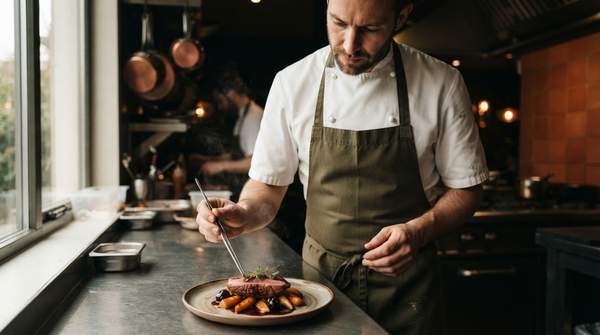
The chef's uniform is not a costume; it is a résumé you can wear. Every element of the traditional outfit—the tall pleated toque, the double-breasted white jacket, the checked trousers, the waist-tied apron—carries both a practical job and a symbolic one, and the two have been tangled together since the sixteenth century. The visual standard that dominates professional kitchens today was set in 1822, when Marie-Antoine Carême sketched two chefs in white hats, double-breasted coats, and aprons for his book Le Maître d'Hôtel Français, and it was carried around the world a generation later by Auguste Escoffier. Understanding who did what, and when, is the difference between seeing a uniform and reading one.
The Enduring Legacy of the Chef's Uniform: A Historical Overview
Chef uniforms have a longstanding reputation as symbols of professionalism and tradition within the culinary field, as the apparel retailer ChefsCloset observes: these garments identify chefs visually in a kitchen, but they also do quieter work maintaining hygiene, ensuring safety, and promoting functionality. That dual character—practical garment and professional emblem—is the through-line of the uniform's entire history. The outfit was never designed at once. It accumulated, piece by piece, over roughly four centuries, with each addition answering a real kitchen problem and, almost incidentally, acquiring a meaning.
What makes the story worth tracing is how few hands shaped it. Two French chefs—Carême in the early nineteenth century and Escoffier at its close—did most of the decisive work, and the French tradition they built became the default professional dress across the Western world. Yet it was never the only tradition, and the Japanese happi jacket shows how a different culinary culture arrived at its own answers to the same questions of cleanliness, discipline, and identity.
Early Origins and the Rise of the Toque Blanche
The oldest piece of the ensemble is the hat. The toque, according to the Wikipedia entry on the chef's uniform, dates back to the sixteenth century—centuries before anyone standardized what a chef should look like. The exact origin of the toque is not specified beyond that century, so its earliest history stays hazy, but its later symbolism is precise. Toque blanche is simply French for "white hat," and different heights of the hat may indicate rank within a kitchen.
The pleats carry their own legend. The number of folds can signify a chef's expertise, with each pleat traditionally representing a technique the chef has mastered. Chef Works relays this account as legend rather than documented fact, and it should be read that way: a story cooks tell about themselves, one that turns a starched cylinder of cloth into a record of mastery. By the time Carême sat down to draw his chefs, the hat was already widely in use; what he added was everything around it.
Marie-Antoine Carême: Architect of the Modern Uniform
Marie-Antoine Carême, widely regarded as the world's first celebrity chef, included a sketch of the chef's uniform in his 1822 book, Le Maître d'Hôtel Français. This illustration depicted chefs in white hats, double-breasted coats, and waist-tied aprons, establishing a visual standard that would shape professional kitchens for the next two centuries. The uniform did not reach widespread adoption immediately, but the template was set.
Carême's decisive contribution was the color. Writing on the uniform's evolution, the apparel site Chef Uniforms credits him with devising the iconic white double-breasted jacket—the "chef's whites"—as a symbol of cleanliness and professionalism. Kamikoto's Tsuyoshi Inagaki adds a nuance worth keeping straight: the hat was already widely in use, but Carême instituted the other elements, including the choice of white. In other words, Carême did not invent the toque; he dressed the chef around it, and in white he made hygiene itself the uniform's visible message.
Auguste Escoffier: Standardization and the Brigade System
If Carême drew the uniform, Escoffier exported it. According to Inagaki's account at Kamikoto, the uniform was brought to Western countries by Georges Auguste Escoffier during his reign at the renowned London restaurants of the Savoy and Carlton Hotels, and its popularity soon spread worldwide. Escoffier's kitchens were famously organized hierarchies—the brigade de cuisine—and the uniform became part of that system's grammar.
The clearest expression of this is the toque itself. Escoffier's era turned hat height into a marker of station: taller hats for senior chefs, shorter ones below them, so that a glance across a busy kitchen told you who was in charge. This is the practical distinction between the two great names of the uniform's history—Carême established what the chef wore, and Escoffier's generation fixed what each rank wore—and it is why the two chefs belong in the same sentence but never in the same job description.
Timeline of the Chef's Uniform Evolution
Read chronologically, the uniform's history falls into a handful of decisive moments. The table below sequences the key developments, attributing each innovation to the correct figure or culture, so the Carême and Escoffier contributions stay distinct rather than blurred together.
| Era / Date | Key Development | Figure / Culture | Significance |
|---|---|---|---|
| 16th century | Toque comes into use | European kitchens | Oldest uniform element; exact origin unspecified beyond the century |
| 1603–1868 (Edo period) | Happi jacket originates as protective wear | Japan | Short kimono-style jacket, first worn by firefighters, later adapted for culinary use |
| 1822 | Uniform's visual standard sketched | Marie-Antoine Carême | White hats, double-breasted coats, aprons in Le Maître d'Hôtel Français; white adopted for cleanliness and professionalism |
| Late 19th century | Uniform carried to Western countries | Auguste Escoffier | Spread from the Savoy and Carlton in London; toque height used to denote rank in the brigade system |
| Modern era | Global variations and partial dress | Worldwide | Full traditional uniform persists; some chefs replace the toque with a skull cap or hairnet |
The sequence makes the division of labor plain: the hat predates everything, Carême defines the whole silhouette in 1822, Escoffier's London kitchens carry it abroad and formalize its hierarchy, and the modern era loosens it. Each row answers a different question—when, what, who, and why it mattered.
Components of the Traditional Chef's Uniform: Function and Symbolism
The toque blanche. The tall, pleated, cylindrical hat is the most recognizable item in a chef's uniform, as Inagaki notes—say the word "chef" and the image of a starched, rounded hat appears. Its height may indicate rank, and its pleats, by legend, count mastered techniques. Practically, it keeps hair contained; symbolically, it announces station.
The white double-breasted jacket. The jacket is the uniform's workhorse. White signals cleanliness and, as Everyday Uniforms explains, connotes authority—the color is used in the traditional uniform to indicate power, and it is also thought to be clean, which is an attribute you want in the person making your food. It has a thermal logic too: white reflects heat rather than absorbing it, a genuine advantage in a hot kitchen. The double-breasted cut is protective, and its reversibility lets a chef hide a stained front before stepping out of the kitchen.
Houndstooth trousers. Loose-fitting pants in the black-and-white houndstooth pattern complete the traditional ensemble. The busy pattern helps camouflage spills and stains—kitchen realism rendered as classic style—and the loose cut suits long hours of movement.
Buttons and apron. Even the buttons speak. Per the Wikipedia entry, qualified chefs wear black buttons while students wear white, so the color of a chef's uniform can indicate rank or role. The waist-tied apron, present in Carême's original 1822 sketch, rounds out the outfit with straightforward protection.
Global Adaptations: Beyond the French Tradition
The French template is dominant, not universal. Japanese chef uniforms, as Clement Design USA recounts, are rooted in centuries-old traditions and have evolved to embody not only the art of cooking but also principles of harmony and discipline. The happi, a short kimono-style jacket, is a quintessential piece of Japanese chef attire; it traces back to the Edo period (1603–1868), where it was initially worn by firefighters as a protective garment before being adapted for other uses, including the culinary world.
What is striking is the convergence. Much like the French, the Japanese emphasize cleanliness in their culinary attire, and white carries the same association of purity in both traditions. Two cultures that never coordinated their wardrobes reached the same conclusion: the person handling the food should look clean, and the clothes should carry the values of the kitchen. Today, many professional chefs continue to wear the full traditional uniform while others forgo the toque in favor of a skull cap or hairnet—tradition bending, but not breaking, to modern practice.
The Enduring Symbolism of Culinary Attire
The reader's takeaway is a decision of interpretation: recognize the chef's uniform as a dynamic symbol of culinary professionalism, hygiene, and tradition—continually evolving while retaining its core historical elements. Carême gave it its shape in 1822, Escoffier gave it its hierarchy and its global reach, and the Japanese happi reminds us that other traditions were writing their own answers in parallel. The measurable indicator of that living legacy is simple to observe: continued adherence to the traditional elements—the toque, the white double-breasted jacket, the houndstooth trousers, the apron—in professional kitchens today, alongside adaptations like skull caps and culturally varied attire that reflect modern needs and diversity.
So long as both are visible in working kitchens, the uniform remains what it has been for two centuries: a garment that tells you, at a glance, who stands at the stove and what they stand for.
Sources
- Exploring the History, Elements, and Role of Chef Uniforms — ChefsCloset
- Chef's uniform - Wikipedia — EN
- A Closer Look at What Makes Chef Uniforms So Special — Chefworks
- Chef Uniform Evolution — Chefuniforms
- Understanding the Professional Chef's Uniform — Kamikoto
- The History of the Chef's Uniform — Everyday Uniforms
- Threads of Tradition: Evolution of Chef Uniforms Across Cultures — Clement Design USA