I've stood in enough kitchenware aisles to know the look: a home cook holding two nearly identical chef's knives, squinting at marketing copy about "German steel" and "surgical stainless," with no idea what any of it means for tonight's onions. Here's the honest answer up front: the best blade material for you is the one whose balance of hardness, toughness, corrosion resistance, and edge retention matches the tasks you actually perform — because those properties pull against each other, and every knife is a compromise.
That's not me being wishy-washy. It's metallurgy. As the metallurgist behind Knife Steel Nerds puts it, steel ratings aren't about ranking which steel is "better" than another, but about understanding balances such as toughness versus edge retention — and heat treatment and edge geometry can matter more for knife performance than the specific steel itself. The best scenario, he writes, is when the steel, heat treatment, and geometry are all selected for the knife and its intended use. So let's figure out your intended use.
Understanding Key Blade Material Properties
Four properties do most of the deciding. Hardness — how well the steel resists deformation — determines how long an edge stays keen. Toughness is how much abuse a blade tolerates before chipping or cracking. Edge retention is how long it stays sharp in use, and corrosion resistance is how well it shrugs off rust and staining from moisture and acidic foods. A blade steel reference from Jantz Supply lists hardness, corrosion resistance, and edge retention among the most important aspects to consider when choosing steel for a knife.
Here's the catch: these properties are in tension. The Cooking Guild frames it well — a chef knife is judged on how sharp it gets, how long it stays sharp, how much abuse it tolerates before chipping, and how easily it comes back on a stone, and "those four properties pull against each other." Harder steel holds an edge longer but is more brittle; tougher steel forgives a careless twist but dulls sooner. You cannot max out every stat. Every knife you buy is a choice about which failure mode you'd rather live with: a dull edge sooner, or a chipped edge catastrophically.
High-Carbon Stainless Steel: The Versatile Workhorse
If there's a default for kitchen use, it's high-carbon stainless steel. KitchenKapers' buyer's guide is blunt about it: most professionally-owned knives are made from some type of high-carbon stainless steel, and if there is a standard for kitchen knives, "it is probably high-carbon stainless steel." The maintenance ask is modest — hand wash, dry, store properly, mostly to preserve the handle. The stainless part means rust isn't a nightly worry, which matters if your kitchen is humid or your cooking leans acidic: citrus, tomatoes, vinegar.
The trade-off is that this category tends toward moderate edge retention and lower toughness than pure carbon steels, per Dalstrong's comparison chart — though that chart's own caveat deserves repeating: it's a general comparison, and specific properties vary by alloy and heat treatment. On the other end of the spectrum sits ceramic: super-hard, lightweight, ultra-sharp, and the longest edge-holder of all — but it can shatter if dropped, may chip or break if used improperly, and, because it's so hard, can't be sharpened on a home sharpener. You'd likely need to send it back to the manufacturer or a specialist. Ceramic is a scalpel, not a workhorse.
Decision Framework: Choosing Your Kitchen Knife Material
Here's the table I wish someone had handed me before my first knife purchase. Match your dominant task to the property that matters most, then accept the trade-off that comes with it. The rows follow directly from the property tensions above: toughness protects against chips but costs you sharpening frequency; hardness buys edge life but invites brittleness.
| If you mostly… | Prioritize this property | Suitable material examples | The trade-off you accept |
|---|---|---|---|
| Chop hard, dense foods (root vegetables, squash, joints and bones-adjacent work) | Toughness — resistance to chipping under impact and twisting | Tough stainless steels suited to kitchen use, such as AEB-L, which holds an edge well, sharpens easily, and offers strong corrosion resistance | The edge dulls sooner, so you sharpen more often — but the blade forgives a careless twist |
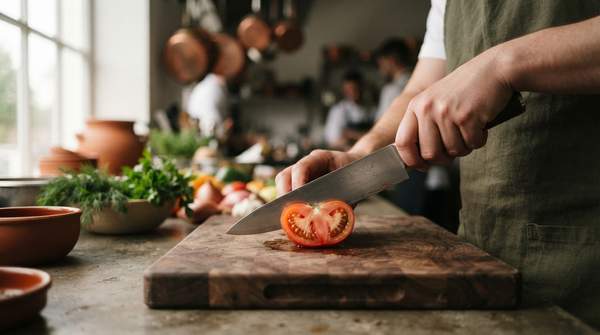
| Do delicate slicing (fish, tomatoes, fine cuts where a keen edge matters) | Edge retention — staying sharp through fine, low-abuse work | Harder steels, or ceramic for its ultra-sharp, longest-lasting edge | Brittleness: ceramic can shatter if dropped and chips if misused; harder steels risk chipping under impact |
| Want one all-rounder for everything | Balanced properties plus corrosion resistance | High-carbon stainless steel — the de facto kitchen standard | Moderate edge retention rather than class-leading; you trade peak performance for forgiveness and low maintenance |
A note on what I left out and why: I haven't given utility and paring work its own row, because the evidence here doesn't detail a distinct material prioritization for those tasks beyond general knife use. And a note on Damascus: it appears in Dalstrong's chart with high wear resistance and edge retention but low corrosion resistance, but its pattern is largely aesthetic for kitchen purposes — the underlying steel's properties are what perform.
Making the Right Choice for Your Kitchen
One more trap to avoid: origin labels are not performance data. The Cooking Guild warns that "Japanese steel," "German steel," and "surgical stainless" are descriptions of origin or grade, not performance. Marketing muddies this, and the longest spec sheet doesn't win — the right balance does. Also worth knowing: heat treatment and edge geometry can outweigh the steel name on the box, which is why two knives in "the same steel" can behave differently.
And the boundaries of this guide, stated plainly: I'm talking blade materials only — not handles, not forged-versus-stamped construction, not brands or prices. The steel categories here are broad ones relevant to kitchen use, not an exhaustive alloy survey, and the advice is aimed at home cooks rather than professionals or knife-making enthusiasts.
Your Culinary Tasks Guide Your Knife Choice
So here's the decision, simply: home cooks should prioritize blade material properties based on their most frequent and demanding culinary tasks, understanding that there are inherent trade-offs between properties like hardness and toughness. If your week is dense with root vegetables and heavy chopping, choose toughness and accept more sharpening. If your cooking is precise and delicate, choose edge retention and treat the blade gently. If you want one knife that does it all without fuss, high-carbon stainless steel is the standard for a reason.
How do you know you chose well? The measurable indicator: you've succeeded when the knife you select has blade material properties — toughness for chopping, edge retention for slicing — that align with your primary cooking activities, and you notice it in improved performance and satisfaction. Watch how the edge behaves over your first few weeks of real cooking. If it chips during your squash prep, you bought hardness when you needed toughness. If it dulls before the week is out on fine slicing work, you bought toughness when you needed edge retention. The knife will tell you whether you read the trade-offs right — you just have to know what it's saying.
Sources
- Knife Steels Rated by a Metallurgist - Toughness, Edge Retention, and Corrosion Resistance - Knife Steel Nerds
- Blade Steel Reference Chart: How to Choose the Best Steel For Your Knife — Jantz Supply
- What is the Best Steel for Kitchen Knives? - TheCookingGuild — The Cooking Guild
- A Buyer's Guide to Kitchen Knives — KitchenKapers
- A Comprehensive Guide to the Different Types of Knife Steel — Dalstrong