The secret to choosing cookware is that no single metal does everything well. Every pan is locked in a trade-off between two competing thermal properties: conductivity, which determines how fast it heats and responds, and heat capacity, which determines how much heat it stores and how stubbornly it holds its temperature. Copper races to temperature and drops just as fast. Cast iron creeps up to heat and then clings to it. Your job as a cook is to match each material's position on that trade-off to the technique at hand.
Introduction: The Science of Sizzle and Simmer
Why does your omelet burn in one pan and your steak refuses to crust in another? It usually comes down to the metal itself. Writing on how thermal conductivity shapes cooking technique, Ivy Cartagenas of Thermtest notes that different metals have specific properties that determine how cookware performs tasks like browning or frying, and that "arguably the most important property" when selecting metal cookware is thermal conductivity. But conductivity is only half the story. How much heat a pan can hold matters just as much for tasks like searing, where a cold steak slams into the metal and threatens to crash its temperature. Understanding both properties—responsiveness and retention—is what lets you stop guessing and start choosing.
Understanding Thermal Conductivity (Responsiveness)
Thermal conductivity measures a material's ability to transfer and distribute heat. Materials with high conductivity take up heat quickly from their environment—and they lose it just as quickly when the surrounding temperature drops, as Cartagenas explains. That two-way speed is the practical magic: a conductive pan doesn't just heat fast, it corrects fast. Turn the burner down and the pan follows almost immediately.
The numbers vary enormously. Compiled engineering data puts copper at roughly 401 W/(m·K) and aluminum at 237, with cast iron down around 80 and stainless steel a sluggish 16. That means a copper pan moves heat dozens of times faster than a stainless one, spreading energy evenly across the cooking surface so one corner of the pan doesn't scorch while the other stays cool. This responsiveness is why high-conductivity pans excel at delicate sauces—when you're a heartbeat away from breaking a hollandaise, you want a pan that listens when you cut the heat.
Understanding Heat Capacity (Retention)
Heat capacity is the other side of the coin: the total internal kinetic energy stored in a material. It's not the same as temperature, which is just the average energy of the molecules. A kilogram of water at 100°F holds more energy than a kilogram of steel at the same temperature—heat capacity depends on mass and material, and since it's a function of mass, you need the density to compare pans of different metals.
Here's where intuition often fails. Aluminum's specific heat is high—about 910 J/(kg·K) versus copper's 390—but copper is far denser. "If you multiply specific heat with density," the Cooking for Engineers reference data shows, "you'll find that the heat capacity per unit volume of steel, cast iron, and copper are about 1.5 times that of aluminum." Density, in other words, buys you stored heat. A heavy cast iron pan at 7,900 kg/m³ is a thermal battery: when cold food hits it, the pan has a deep reserve of energy to spend on a hard sear before its temperature meaningfully drops.
The Cookware Material Trade-Off: Responsiveness vs. Retention
Now put the two properties together, and the trade-off becomes clear. The materials that respond fastest to the flame—copper and aluminum—store less heat per unit volume, so they're nimble but light on reserve. The dense, heavy materials—cast iron and steel—hold heat stubbornly but are slow to change course. Neither wins; they just solve different problems.
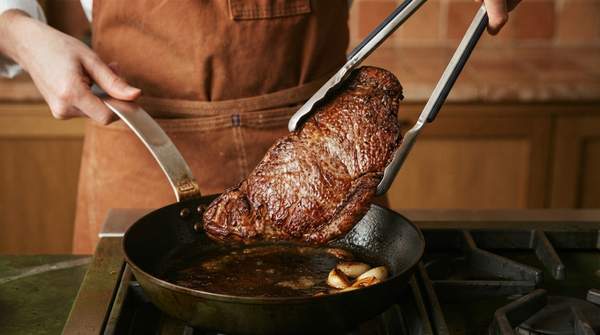
Take searing, where this trade-off causes the most kitchen confusion. For a hard crust on meat, the ability to retain heat against the thermal shock of cold food is paramount: if the pan surface plummets the moment the steak lands, you steam instead of sear. Cast iron's high density gives it that stability. Conductivity still matters—it determines how quickly the burner can replenish the heat the food drains—but the stored reserve does the heavy lifting. Delicate sauce work flips the priority: you want a pan that responds instantly when the heat changes, which is copper's home turf and cast iron's worst nightmare. Sautéing sits in between, favoring quick, even heating.
Cookware Material Performance Matrix
Here's the side-by-side comparison that turns the physics into a shopping decision. It correlates each material's measured conductivity and per-volume heat capacity with how that actually behaves at the stove, so you can match the pan to the technique.
| Material | Heat Responsiveness (Conductivity) | Heat Retention (Capacity) | Best For | Considerations |
|---|---|---|---|---|
| Copper | Highest—about 401 W/(m·K); heats and cools very fast | Lower retention than dense alternatives; quick temperature changes | Delicate sauces, quick frying, tasks needing instant control | Fast response works against sustained high heat; expensive; unlined copper shouldn't touch acidic foods like tomato or lemon |
| Aluminum | High—about 237 W/(m·K); heats and cools quickly | Moderate—stores less heat per volume than dense metals | Sautéing and even, everyday heating on a budget | A leading cookware metal for its balance of conductivity and cost |
| Cast iron | Low—around 80 W/(m·K); slow to heat, needs time to reach temperature | Excellent—dense (7,900 kg/m³) metal holds stable temperature under load | Searing, browning, and slow, steady cooking such as stewing | Slow to adjust; requires more time to reach desired temperatures |
| Stainless steel | Poor—about 16 W/(m·K); slow and uneven unless reinforced | Good retention once at target temperature | Effective for searing and browning when properly preheated; all-purpose durability | Often paired with aluminum or copper cores to improve heat distribution |
Read the verdict straight from the table: cast iron wins searing because its retention defends the cooking temperature when food goes in; copper wins delicate sauces because its responsiveness lets you steer temperature in real time; aluminum wins quick sautéing and budget-friendly even heating; stainless wins durable all-purpose work, especially in pans boosted by an aluminum or copper core. Cartagenas's guidance matches the physics: for stewing or slow cooking, favor lower-conductivity materials like cast iron, while quick frying and boiling water call for higher-conductivity metals like copper or aluminum.
Choosing Your Pan for the Technique
One caveat before you buy: these rankings describe the intrinsic metals. Actual performance of a specific product depends on thickness, construction quality, and design—a thin cast iron pan won't retain heat like a heavy one, and a cheap copper-plated pan isn't a copper pan. (This article focuses on the core metals, not non-stick coatings or glass, and doesn't address clad construction or metal-reactivity safety questions in depth.)
So how do you decide in the moment? Ask one question: does this dish need the pan to change temperature fast, or to resist changing temperature? Searing a steak, charring vegetables, or frying in batches: retention wins—cast iron, or preheated stainless. Simmering a sauce gently or reducing cream: responsiveness wins—copper or aluminum. Boiling water for pasta: conductivity, since aluminum or copper gets there faster. And when a recipe needs both—steady heat now, quick adjustment later—reach for stainless steel's middle path and preheat it patiently.
Building Your Ideal Cookware Collection
To build a versatile cookware collection, prioritize a combination of materials that balance high responsiveness for delicate tasks with high heat retention for searing and even cooking. You don't need one of everything—most kitchens benefit from a mix rather than a single type, and a balanced system covers convenience, heat tolerance, and durability together.
A practical starter set: a stainless steel pan for all-purpose cooking and durability, a cast iron skillet for searing and oven work, and an optional aluminum or copper piece for responsive, temperature-sensitive tasks. That trio handles the week: stainless for the Tuesday stir-fry and pasta water, cast iron for the weekend steak, the responsive pan for the custard you don't want to scramble. The measurable indicator of success is simple: a kitchen equipped with at least one stainless steel pan for all-purpose use and a cast iron skillet for searing, with optional aluminum or copper for specialized tasks. Hit that mark, and every technique in your repertoire has a pan whose physics is already on your side.
Sources
- Thermal Conductivity Impacts on Cooking Technique — Thermtest
- Compare Frying Pan Thermal Properties — Resources
- Common Materials of Cookware - Equipment & Gear - Cooking For Engineers — Cookingforengineers
- Cookware Material Matrix: Compare Heat, Safety, and Performance — Kitchen Marks