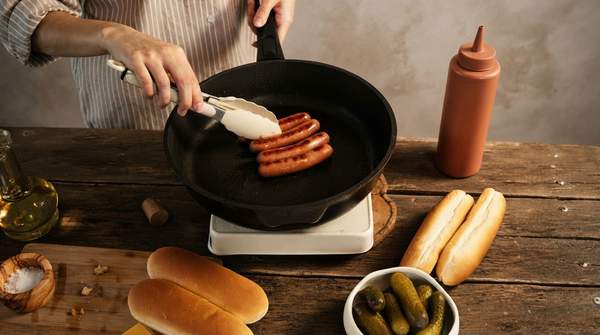
Sausages split for one core reason: heat builds steam and pressure inside the casing faster than the skin can stretch, and the casing eventually gives way. The fix is not a trick or a gadget — it is patience, applied as gentle, even heat. Food experts consulted by the Daily Mirror and the Daily Express agree that cooking over medium or medium-low heat, turning regularly, and resisting the urge to pierce the skin will keep most fresh sausages intact. This guide applies to uncooked sausages in natural or artificial casings — standard pork or beef links — cooked with home stovetop or oven equipment, not pre-cooked frankfurters or skinless sausage meat.
Common Mistakes to Avoid for Intact Sausages
The two habits most likely to ruin a sausage are the two most people learned at someone's elbow: pricking the skin and starting on high heat. Both are, in the words of the experts quoted, relics of an older school of cooking that actively works against a juicy result.
Piercing the casing is the first to go. Richard Turner, co-founder of the butchery Turner & George, told the Daily Express that pricking is unnecessary — "this is an old wives' tale and allows precious juices to escape along with the fat, which is the flavour." The same message comes through in the Mirror's reporting: a good butcher's sausage is made to keep its juices inside, so the casing should be left to do its job. Pricking simply opens a drain for the moisture and fat that carry most of the taste. Food writer Carla Lalli makes the same point from the cook's side: piercing to check doneness "unleash[es] a geyser of hot fat and juices, drying out the finished product."
The second mistake is heat. Casings split when raw sausages go over high heat, because the proteins in the filling contract and bulge quickly and the skin rips. Starting hot does not save time; it trades a few minutes for a burst casing and a pan of escaped fat.
Mastering Temperature Control: The Golden Rule
Every expert source converges on the same principle: keep the heat low and even. Steven Carter Bailey, food expert at ProCook, told the Express that "patience is key," advising cooks to start over medium heat because high temperatures cause casings to burst, and to turn the sausages regularly so colour develops gradually and they cook evenly. The mechanism, as the Mirror's reporting puts it, is that "when the heat gets too high, steam and pressure build up inside the sausage and the skin eventually bursts, allowing precious moisture and flavour to escape."
Heat is the main lever, but it is not the only variable. A casing packed too tightly has less room to stretch as the filling expands, and any air trapped inside the sausage gives the pressure somewhere to accumulate — both make a burst more likely even at moderate heat. That is why gentle heat matters twice over: it raises the internal temperature slowly, giving steam a chance to escape through the casing's natural give rather than tearing it open. If you see a sausage about to split, the remedy is immediate: take it off the heat and lower the temperature rather than pushing through.
Sausage Cooking Methods: A Comparison for Casing Integrity
Two techniques dominate the expert advice, and they manage heat and pressure differently. The table below compares them across the factors that matter for an intact casing — heat level, splitting risk, time, and the texture you get at the end.
| Cooking Method | Heat Level & Control | Splitting Risk | Typical Time | Browning/Texture Outcome |
|---|---|---|---|---|
| Poaching first, then searing | Gentle simmer in water, beer or broth — never a boil; heat raises internal temperature slowly | Lowest — gentle cooking renders fat without shocking the casing | About 10–15 minutes to cook through, plus a short sear | Juicy, evenly cooked interior; casing browned afterwards in a hot pan or on the grill for snap and colour |
| Slow pan-frying | Low to medium heat in a heavy-based pan; reduce heat further if colouring too quickly | Low if heat is managed and sausages are turned regularly; high if rushed | About 30 minutes, turning occasionally | Gradual, even browning; juicy interior if the casing holds |
The comparison shows the trade-off clearly. Poaching first offers the lowest splitting risk and the most control: because the sausage is already cooked through when it hits the pan or grill, the fierce heat only has to brown the casing, not cook the filling. Pan-frying from raw delivers browning in one step, but it demands more discipline — the heat must stay low, the sausages must be turned every few minutes, and a splash of water with the lid on early can help the insides catch up to the outsides. Turner's method of frying "low and slow" for about 30 minutes in a heavy-based pan, sprinkling a little water if the colour develops too fast, is the classic single-pan version of the same principle.
Achieving Perfectly Cooked, Intact Sausages
To consistently cook sausages without splitting, prioritize gentle, even heat application and avoid practices that rapidly increase internal pressure or compromise casing integrity. In practice that means: never pierce the skin, never start on high heat, and choose poaching-first when you want maximum insurance or slow pan-frying when you want one pan and gradual colour. The measure of success is simple and visible: the casings stay smooth and unburst throughout cooking, and the meat inside is evenly cooked rather than charred at the edges and raw at the centre. When a sausage comes off the heat with its skin intact and its juices still inside, the pressure problem has been solved — and dinner is better for it.