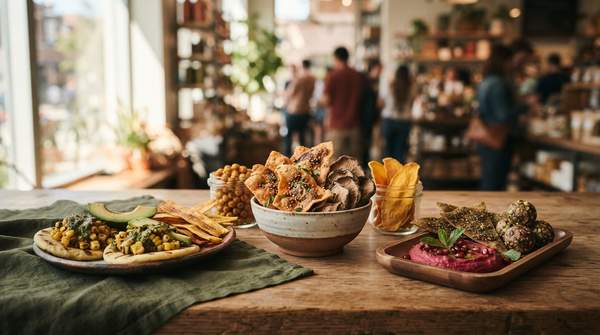
The next plant-based snack you tear open probably isn't trying to impersonate a burger. The most interesting work in this space now pairs a widening palette of plant proteins—faba bean, hemp, yellow peas, red lentils, chickpeas, mushrooms—with advanced processing techniques such as high-moisture extrusion, shear cell technology and 3D printing. The result is a new generation of textures: fibrous, flaky, layered, dense. Understanding that ingredient-plus-technology equation is the key to reading any modern snack label like an insider.
The New Era of Plant-Based Snacking
I've watched this category grow up, and the shift is unmistakable. The early waves of plant-based snacking were defined by simple substitution, as Food Business Review puts it—swapping potato starch for corn, or dairy for soy. Today, the industry is instead characterized by what that trade publication calls "whole-ingredient integrity" and advanced processing methods that improve bioavailability.
The ambition has changed too. Writing for EnWave, Gabriela Patricio describes an innovation imperative that "extends beyond mimicry to creating entirely new food experiences that leverage the distinctive qualities of plant-based ingredients rather than treating them as inferior substitutes." That resonates especially with younger consumers who, in her framing, don't want exact replicas of conventional products—they want exciting new foods that happen to be plant-based. The snack industry, in SNAC International's telling, is meeting demand for "exciting new taste experiences" with products that "push the boundaries of flavor and texture."
Novel Ingredients: Beyond Traditional Plant Proteins
So what's actually going into these snacks? Griffith Foods, an ingredients specialist, notes that processors are experimenting with a broader bench of substitutes than ever: mushrooms, pulses, lentils, chickpeas, bean powders and ancient grains. The company adds a caveat worth remembering—willingness to consume these alternatives differs around the world, and acceptance may require educating consumers about what these ingredients are supposed to taste like, rather than masking them to imitate meat.
On the research side, a review of shear cell technology and ingredient roles in fibrous plant-based meat analogs—published in ACS Food Science & Technology—lays out the building blocks: plant-based meat analogs typically use proteins at 20 to 50 percent, polysaccharides at 2 to 30 percent, and lipids at 0 to 5 percent. Those components are crucial in defining texture, while other additives handle flavor, color and nutrition. In other words, texture isn't an accident of the recipe; it's engineered from the macronutrient scaffold upward.
Advanced Processing Technologies: Crafting Texture and Flavor
Here's where the magic becomes mechanics. Extrusion, as described in a review of plant-based food formulation trends by Christabel Tachie, Ifeanyi D. Nwachukwu and Alberta N. A. Aryee, mixes all ingredients, then preconditions, cooks and extrudes them through dies; the extruded product can then be trimmed, marinated and ground depending on the company's specifications. It's the industrial-scale workhorse for shaping plant matter into snackable form.
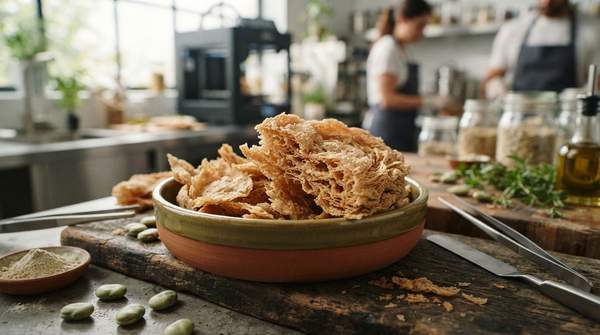
Shear cell technology is the more intriguing newcomer. Bright Green Partners, a consultancy focused on alternative proteins, highlights it alongside ohmic heating, 3D printing and electrospinning as developments revolutionizing production, noting that shear cell technology can create a fibrous texture in plant-based meat alternatives. The ACS review gets more granular: shear cells operate at moderate shear force and 90–140°C, with residence times under 20 minutes, low energy consumption and moderate equipment cost—compared with high-moisture extrusion's higher shear force, 130–160°C, 2–5 minute residence time and industrial-scale throughput. Shear cell products come out fibrous and layered; extrusion products dense and fibrous; freeze structuring yields flaky, less dense products.
The Plant-Based Snack Innovation Matrix
This is the framework I wish every snack aisle came with. Read it left to right: the ingredient, the technology applied to it, and the texture you'll actually experience. The specific textural outcome always depends on the ingredient used and the precise parameters of the process—these are the pairings the evidence supports.
| Ingredient Category | Processing Technology | Resulting Texture |
|---|---|---|
| Legumes (faba bean, hemp, yellow peas, red lentils) | High-moisture extrusion and shear cell technology | Fibrous, juicy structures—particularly effective for meat analogs |
| Legumes (faba bean, hemp) | Shear cell technology | Flaky structures; fibrous structures do not require deformation during cooling |
| General plant ingredients | Shear cell technology (high pressure applied to raw materials) | Improved texture, plus enhanced digestibility, nutritional profile, flavor and shelf life |
| General plant ingredients | 3D printing | Diverse textures and flavors; a key driver of plant-based food innovation |
| General plant ingredients | Extrusion through dies, followed by trimming, marinating, grinding | Structured, shaped commercial products built to specification |
Notice what the matrix quietly admits: the strongest evidence links legume proteins to shear cell and extrusion work. The fungi and algae stories are real threads in the broader innovation conversation, but the specific technology-to-texture pairings documented in the research I've drawn on center on pulses—which is itself telling. The workhorse ingredients of this era are the humble ones: faba bean, hemp, yellow pea, red lentil.
Driving Innovation: Beyond Mimicry and Towards Clean Labels
Why bother with shear cells and 3D printers at all? Because the payoff isn't just novelty. Patricio's EnWave piece describes how gentle moisture removal concentrates natural flavor compounds rather than damaging them, "reducing or eliminating the need for extensive flavor masking additives commonly required in conventionally processed plant-based products." The same technological capabilities, she writes, can reduce or eliminate artificial preservatives, texture modifiers and flavor enhancers—a significant advantage in a market where ingredient scrutiny keeps intensifying among younger consumers.
The other driver is texture itself. Food Business Review identifies a "textural renaissance of free-from products" as one of three pillars powering the transition, alongside the technological maturation of plant-based formulations and clinical fortification of everyday foods. SNAC International frames the same impulse from the consumer side: snacks that "nourish the body, excite the palate, and support a more mindful way of living." When a shear cell turns faba bean protein into something flaky and layered, that's not mimicry—that's a texture that didn't exist before, and it's the whole point.
Recognizing Innovation in Your Next Plant-Based Snack
Consumers can better appreciate and select plant-based snacks by understanding the specific ingredients and processing technologies that contribute to their unique textures and flavors. The measurable indicator is simple: the presence of novel ingredients (e.g., mycelium, algae, faba bean) and descriptions of specific textures (e.g., fibrous, flaky, crispy) on product labels or marketing materials. When you spot faba bean paired with a fibrous, layered bite, you're looking at shear cell science on a shelf. When a puff holds its structure through a die, that's extrusion doing quiet, precise work. The label is a map—now you know how to read it.
Sources
- Transforming Snacks Through Scientific Insights and Innovation — Food Business Review
- How is food tech transforming plant-based innovation? - EnWave
- Nutrition Narrative — Innovation at Every Bite — SNAC International
- Griffith Foods — Griffith Foods - Asia Pacific
- Kinampark
- Trends and innovations in the formulation of plant-based foods - Food Production, Processing and Nutrition — SpringerLink
- The latest technological innovations in plant-based food processing - Bright Green Partners — Bright Geen Partners