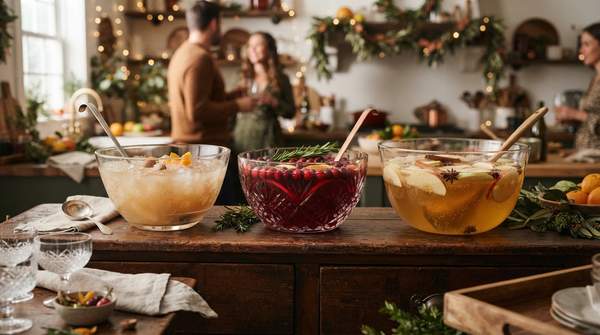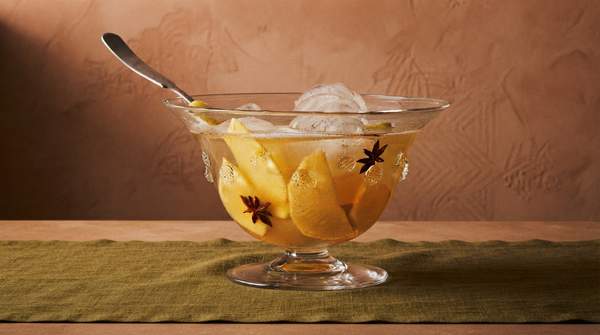
The punch bowl is the rare holiday tradition that actually reduces a host's workload rather than adding to it. Instead of shaking cocktails one at a time while your guests mingle without you, you mix a single large batch, set out a ladle, and rejoin your own party. The reason punch works so elegantly in this role is structural: from its earliest recorded days, the drink was built from just five components—strong, weak, sweet, sour, and spice—a formula flexible enough to survive three centuries of changing ports, spirits, and tastes.
A Sip Through Time: The Rich History of Punch
Punch began at sea, in the practical world of long-haul sailing rather than at any refined table. As a Virginia Tech research guide on cocktail history recounts, sailors traveling the globe in the age of exploration found that beer went flat in hot climates, but nearly any port offered a local spirit distilled from sugar, rice, or fruit, some form of citrus, and unfamiliar spices worth trying. Out of these port-side improvisations came a combination of spirits, sugar, water, citrus, and spices—something that could be made on board just about any ship carrying goods from the East Indies, and later from the West Indies and Caribbean.
The drink's name may encode its own recipe. A Slate essay on holiday punch traditions notes that the earliest known reference appears in a 1638 letter from Surat, in the British milieu of India, where citrus, sugar, spices, water, and arrack—a South Asian spirit made from palm sap—were first combined under the name "punch." Popular etymology has linked the word to the Hindi word for five, paanch, matching the five core ingredients, though the cocktail historian David Wondrich, whose book on punch the Virginia Tech guide also recommends, has questioned that origin story. Rather than a purely Indian invention, the recipe seems to have evolved from the mingling of cultures aboard ships sailing between distant ports.
Sailors then carried the concept home, and punches spread through Europe and eventually America, where the Virginia Tech guide notes the original five ingredients varied by location and availability. Over the nearly three centuries since punch took hold, its definition has expanded considerably—but the five-part skeleton remains a genuinely usable design principle, not just a historical curiosity.
The Punch Rule of Five: Your Custom Punch Builder
The framework below sorts your ingredient options into the five historical components. To build a balanced punch, make a deliberate choice in each row—one or more items per category—then adjust to taste. The categories do distinct jobs: the strong element supplies the alcoholic backbone, the sour element cuts through sweetness and richness, the sweet element softens the sour, the weak element dilutes and integrates everything, and the spice element finishes the composition.
| Component | What It Does | Ingredient Choices |
|---|---|---|
| Strong | The alcoholic base of the punch, providing its primary spirit. | Historically arrack; today rum, brandy, or gin are common choices. |
| Sour | Provides balance and brightness, cutting through sweetness and richness. | Citrus juice, typically lemon or lime; freshly squeezed is generally preferred for optimal flavor. |
| Sweet | Balances the sourness and enhances the overall flavor of the punch. | Sugar is the traditional sweetener, often in syrup form; honey or a fruit liqueur can also serve. |
| Weak | Dilutes the strong components and integrates the flavors; crucial for drinkability and volume. | Water is the classic diluent; tea, juice, or sparkling wine can substitute, and the choice significantly shapes the final flavor profile. |
| Spice | The finishing element that completed the original five-part formula. | Historically, whatever spice a given port had on offer—the most open-ended slot in the framework. |
Two qualifications keep this framework honest. First, the ingredient examples are illustrative rather than exhaustive; they reflect the historical record and common modern practice, not a fixed canon. Second, this is a set of principles, not a rigid recipe—the whole point is that the five slots can be filled differently for every occasion, which is precisely how the drink traveled the world in the first place.
Crafting Your Custom Punch: A Worked Example
To see the framework in motion, walk the rows in order. Choose a strong element—say, rum, the spirit most associated with the Caribbean trade routes punch later traveled. Add a sour element: lemon or lime juice, squeezed fresh. Choose a sweetener—sugar in syrup form dissolves most readily into a cold punch. Pick your weak element next, and consider it carefully: water keeps things classic, while tea or sparkling wine shifts the entire character of the bowl. Finally, decide on your spice, the most flexible slot, drawn from whatever suits the season.
The practical advantage over individual cocktails is arithmetic as much as tradition. A punch is mixed once, in one vessel, before guests arrive; every subsequent serving is a ladle rather than a production. The host steps out from behind the bar cart, and the bowl itself becomes a gathering point—guests serve themselves and each other, which is the communal role the drink has played since sailors first assembled it from whatever their ports provided.
One boundary worth naming: this framework covers the classic five-part tradition. It deliberately does not extend to modern non-traditional punches built on sherbet or soda as a primary base, and it is not an exhaustive recipe collection. It is a design system for the original style of the drink.
Embrace the Punch Bowl: A Stress-Free Holiday Tradition
Hosts should consider serving a punch bowl at their next holiday gathering to reduce stress and enhance the guest experience. The decision is straightforward: a drink built on a five-part formula that has survived since the seventeenth century does not need you to reinvent it, only to fill its five slots with ingredients you enjoy. The measurable indicator of success is equally simple—the host is able to relax and engage with guests rather than continuously preparing individual drinks. If you find yourself holding a ladle instead of a shaker, and standing among your guests instead of behind a bar, the tradition has done its job.