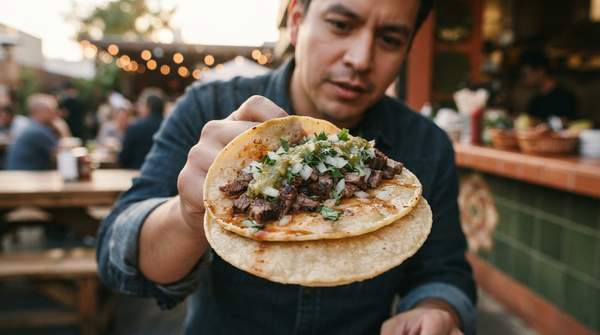
That second tortilla under your street taco isn't generosity or ritual — it's engineering. The two tortillas do different jobs: the inner one absorbs the juices, fat and salsa and goes soft, while the outer one stays dry and holds everything together. It's a two-part system, and once you see it, you can't unsee it. Better yet, it doubles as cheap insurance for the taquero, whose most expensive ingredient is the meat, not the masa.
The Two-Tortilla System: A Visual Explainer
The part most people miss, as one restaurant's explanation of the practice puts it, is that the two tortillas aren't doing the same job twice. They're a complementary pair, and each layer's material properties determine its role. Here's how the system breaks down:
| Layer | Structural Property | Role in the Taco | Why It Works |
|---|---|---|---|
| Inner corn tortilla | Starch-based, no gluten; weakens quickly when hot, fatty, acidic filling breaks down its starch | Sacrificial moisture absorber — takes the juice, fat and salsa, goes soft | It's not load-bearing, so going soft doesn't matter |
| Outer corn tortilla | Stays dry because the inner layer absorbed everything before moisture reached it | Structural layer — provides all the integrity, and is what your fingers actually hold | Remains firm long enough to finish the taco even if the inner layer fails |
| Both together | Two thin tortillas flex better than one thick one | A wrapper that bends without cracking at the fold | A single thick tortilla is stiffer and eats more like bread than a wrapper |
The failure mode this system solves is specific and fast. A corn tortilla is masa — nixtamalized corn, water and lime, with no gluten holding it together. Its structure comes entirely from starch, and starch has a weakness: put hot, fatty, acidic filling on it, and moisture starts breaking it down almost immediately. Within a minute or two, the center goes translucent, then slack, then tears — usually at the fold, usually while you're holding it over your shirt.
Food writer Lesley Téllez, author of Eat Mexico: Recipes From Mexico City's Streets, Markets and Fondas, describes the same dynamic from the vendor's side: "Particularly with a liquidy filling like a guisado, the first tortilla breaks. So the second tortilla serves as back up." Mexico City street vendors often serve tacos on two tortillas by default, or ask customers whether they want one or two. The doubling is especially common with wetter fillings like birria or guisado, where a single layer simply can't survive the meal.
The Economic Logic: Inexpensive Insurance for Valuable Fillings
There's a business calculation underneath the technique, and it's not about generosity. Street tortillas are small and thin, and they're the cheapest component of the taco by a wide margin. The filling — the meat — is the expensive part. A torn tortilla drops the expensive part on the ground, and a taco that fails mid-meal is a taco the customer remembers for the wrong reasons.
So the second tortilla is insurance that costs almost nothing, applied to a product whose failure mode is losing the filling entirely. Gustavo Arellano, who answered this exact question in his syndicated "Ask a Mexican" column, treats the doubling as the practical taquero solution it is rather than a tradition with deep symbolism attached. The practice became customary because it works — not the other way around. For a vendor moving dozens of tacos a night, a fraction of a cent of extra masa per taco is a trivial premium for guaranteeing the carnitas arrive in your mouth instead of on the pavement.
Corn vs. Flour: Why the Double-Up is Specific
You've probably noticed you never see this with a burrito, and there's a material reason. Flour tortillas are made with wheat flour, water, salt and fat, and the gluten in wheat gives them elasticity, while their fat content resists moisture. They don't go slack the way corn does, so they don't need backup.
Corn tortillas, by contrast, have no gluten at all — their structure is pure starch, which is exactly the substance that hot, juicy fillings break down. That asymmetry is the whole reason the problem belongs to corn. Flour tortillas are also better suited to heavier or wetter fillings precisely because they're sturdier than their corn counterparts, which is why northern Mexican cuisine, with its burritos and large quesadillas, leaned into the flour tradition while corn remained the classic taco wrapper.
The doubling also preserves something a single thick tortilla can't: the texture. Two thin tortillas flex better than one thick one, which would be stiffer, crack at the fold, and eat more like bread than like a wrapper. The system keeps the delicate corn flavor and pliability while buying the strength corn alone can't provide.
Making the Most of Your Taco Experience
Appreciate the practical and economic ingenuity behind the double-tortilla practice when enjoying street tacos — it's a small, everyday piece of culinary engineering, not a mystery. And know that you have options: many people peel off the second tortilla and split the filling into two smaller tacos, which vendors consider a perfectly normal move. How you eat your taco is up to you.
You can watch the system work in real time, too. The measurable indicator of success is right there in your hands: the inner tortilla becomes moist and pliable as it absorbs the juices and fats, while the outer tortilla remains firm, successfully containing the filling until the last bite. When that outer layer holds all the way through, the taquero's cheap insurance has done exactly what it was designed to do.
Sources
- Why Corn Tortillas Are Failing Your Tacos (And The One-Second Fix) - Tasting Table
- Why Street Tacos Come With Two Tortillas — Julia's Mexican Restaurant
- The History of Tortillas: The Foundation of Mexican Food - Don Pedro's Heber
- Ask a Mexican: Why Do Taco Trucks Always Serve Tacos With Two Tortillas? - Coachella Valley Independent